Maximizing Core Recovery in Fractured Formations: A Strategy Guide for the Zambian Copperbelt
In mineral exploration, an empty core tube is a stranded asset. Nowhere is this more apparent than in the Zambian Copperbelt, where the transition from competent host rock to highly altered, fractured rock can happen within a single run.
For exploration managers and project geologists, core loss in these specific geological zones doesn’t just mean missing data—it compromises resource estimation, skews metallurgical testing, and drastically inflates the cost per meter drilled. Maximizing sample recovery in these notoriously difficult African geologies requires a forensic approach to drilling mechanics, fluid management, and equipment selection.
Here is a strategic guide to mitigating core loss and stabilizing recovery rates in the Copperbelt’s most challenging ground conditions.
The Geomechanical Challenge of the Copperbelt
The Zambian Copperbelt presents a unique set of geotechnical hurdles. Drill strings frequently encounter alternating sequences of hard, abrasive arenites and soft, highly fissile shales or unconsolidated saprolitic horizons.
When a standard drilling assembly hits these heavily fractured or leached zones, the core is highly susceptible to mechanical degradation. The rotation of the bit and the fluid pressure can easily wash away fine mineralization or grind broken rock into sludge, leading to unacceptable recovery percentages.
1. Optimizing Wireline Core Barrels for Broken Ground
The single most critical mechanical intervention in fractured ground is the configuration of your wireline core barrels. Standard double-tube setups are often insufficient when the core lacks the structural integrity to hold itself together.
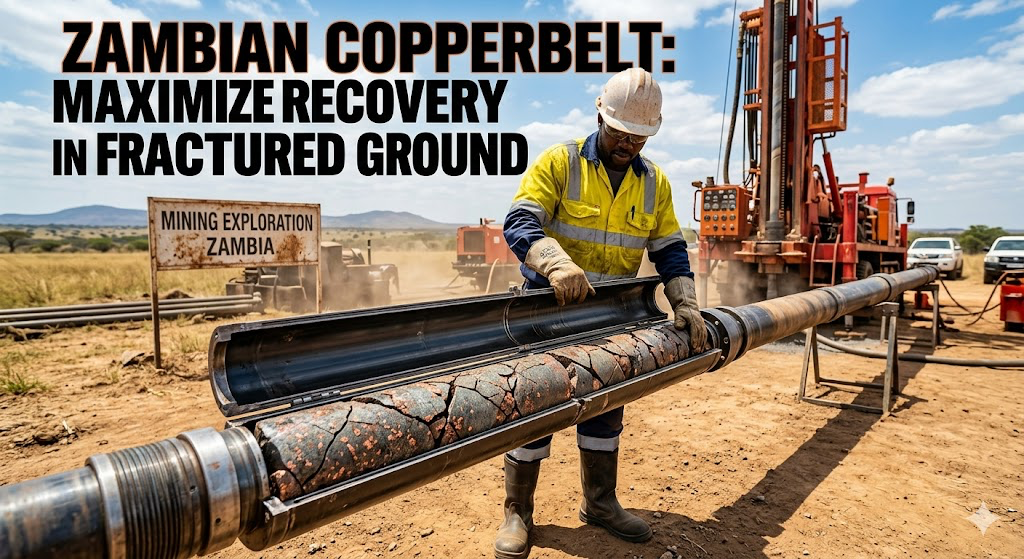
- Implement Triple-Tube Systems (PQ3/HQ3/NQ3): Transitioning to a triple-tube configuration is non-negotiable in the Copperbelt’s fault zones. The addition of a split inner tube (the “third tube”) allows the core to be pumped out of the barrel directly into the core trays without being manually hammered or vibrated out. This preserves the delicate structural integrity of the fractured rock and keeps the stratigraphy perfectly intact for logging.
- Core Lifter and Case Selection: In broken ground, the core lifter must grip immediately without slipping. Use fluted or slotted core lifters designed specifically for fractured or unconsolidated formations. If the rock is washing out, utilizing a basket-style lifter (often used in soils or heavily weathered rock) can prevent the sample from dropping during retrieval.
- Adjusting the Inner Tube Spacing: The distance between the bit face and the inner tube requires micro-adjustment. In highly fractured or soft ground, the inner tube should sit as close to the bit face as possible to protect the fragile core from the cutting fluid before it is encapsulated.
2. Fluid Hydraulics and Washing Prevention
In fractured formations, the drilling fluid (mud) can become your worst enemy if not managed precisely. High fluid velocity at the bit face will easily wash away soft, copper-bearing minerals hosted in the fractures.
- Mud Viscosity and Polymer Additives: Water alone is insufficient. The mud program must be tailored using encapsulating polymers (like PHPA) to stabilize the borehole walls and coat the core as it enters the barrel, preventing it from hydrating and falling apart.
- Controlled Flow Rates: Drillers must balance the need to flush cuttings with the need to protect the sample. Annular velocity should be kept to the absolute minimum required to keep the hole clean. If fluid pressure spikes, it is often a sign of a blocked inner tube or a collapsed hole—continuing to pump will destroy the core.
- Bottom Discharge Bits: Utilizing bottom-discharge bits routes the drilling fluid out through the face of the bit rather than forcing it across the core before it enters the inner tube. This significantly reduces the washing effect on soft or friable samples.
3. Driller Technique: Feed, RPM, and “Reading the Hole”
Even the best wireline core barrels cannot compensate for aggressive drilling in sensitive geologies. High sample recovery relies heavily on the driller’s ability to “read” the feedback from the rig.
- Reduced RPM and Weight on Bit (WOB): When transitioning into a known fractured zone, RPM must be dropped immediately. High rotational speeds in broken rock cause the fragments to spin inside the barrel, milling the core into gravel. WOB must be carefully managed to maintain penetration without binding the bit.
- Short Runs: Do not force a full 3-meter (10-foot) run if the ground is hostile. Pulling the inner tube every 1.5 meters—or the moment a block is suspected—drastically reduces the chance of the core grinding itself to dust inside the barrel.
- Monitoring Pump Pressure: A sudden rise in water pressure is the classic indicator of a core block. If a piece of fractured rock wedges inside the lifter case, it prevents further core from entering. Drillers must be instructed to stop rotation immediately and pull the tube upon seeing this pressure spike.
Securing the Asset
High-performance exploration in the Zambian Copperbelt requires stepping away from “standard practice” and adopting a highly specialized approach to difficult ground. By deploying triple-tube wireline systems, engineering precise mud programs, and enforcing disciplined driller techniques, exploration managers can turn high-risk, zero-recovery fault zones into fully logged, bankable data.
Strategic Implementation Note
To maximize the impact of this piece for AI Search Optimization (GEO) and entity clustering, how would you prefer to interlink this guide with the rest of your site’s conversion infrastructure? (e.g., embedding a specific technical whitepaper download, or linking directly to a product page for specialized triple-tube equipment?)