Core Recovery in Broken Ground: Practical Adjustments That Save African Drill Programs
A drilling program begins in competent ground. Penetration rates are stable. Core recovery exceeds 95 per cent. Logging progresses smoothly.
Then the formation changes.
The bit enters a fractured shear zone. Recovery drops to 68 per cent. Core trays begin showing broken fragments and ground-up material. Blocks wash away. Geological confidence drops. Confirmation drilling is requested. Feed pressure is increased to maintain penetration. Vibration increases. Torque spikes. Recovery falls further.
Within days, productivity slows, and the program begins to drift off budget.
This scenario is common across Southern Africa. From weathered zones in the Northern Cape to fractured greenstone belts in Zambia and the DRC, broken formation drilling is predictable.
The difference between a controlled program and an overrun program is how operators respond.
To improve core recovery, African operations must treat fractured ground as both a mechanical challenge and a commercial risk.
Why Core Recovery Fails in Broken Ground
Core recovery failure is rarely caused by a single issue. It is typically the result of formation conditions, mechanical mismatch, and operational discipline interacting.
Formation Conditions
Fractured ground introduces structural instability.
Common conditions include:
- Shear zones with displaced rock blocks
- Highly jointed rock mass
- Weathered transition zones
- Faulted contact areas
- Broken and decomposed formations
In these environments, the formation does not remain intact during rotation. Blocks separate. Fines wash out. Core fractures inside the barrel.
Without controlled adjustments, recovery declines quickly.
Mechanical Causes
Broken formation drilling requires mechanical adaptation.
Common mechanical contributors include:
- Incorrect bit matrix hardness
- Excessive rotational speed
- Aggressive feed pressure
- Worn reaming shells
- Incorrect core barrel configuration
High RPM in fractured ground increases fragmentation. Excessive feed pressure forces unstable blocks apart. Both reduce core integrity.
Mechanical aggression worsens recovery.
Operational Causes
Even properly specified tooling can underperform if operational control slips.
Operational contributors include:
- Inconsistent torque discipline
- Poor hole cleaning
- Delayed response to vibration changes
- Inadequate monitoring of torque spikes
- Inconsistent fluid mixing
Fractured ground communicates through mechanical signals. Ignoring those signals leads to escalating core loss.
The Commercial Impact of Core Loss
Core recovery is not just a geological metric. It is a financial metric.
Consider a 1,200-meter exploration campaign targeting 95 per cent recovery.
If recovery drops to 75 per cent across fractured zones, confirmation holes may be required. Assume an additional 200 meters are drilled due to recovery uncertainty.
If rig operating cost averages R18,000 per hour and penetration averages 2.5 meters per hour in broken formation, those additional meters significantly increase total program cost.
Additional meters increase:
- Labour exposure
- Fuel consumption
- Consumable wear
- Camp overhead
- Reporting delays
A 20 per cent recovery loss in key intervals can materially inflate total drilling cost.
Recovery discipline protects cost-per-meter.
Practical Adjustments That Improve Core Recovery Africa Operators Can Apply
Improvement requires deliberate mechanical control.
Adjust the Bit Matrix to the Formation
Bit matrix selection must reflect ground conditions.
Softer matrices perform better in certain fractured but less abrasive zones because they cut rather than grind.
In abrasive fractured ground, matrix hardness must balance wear resistance with stability.
Standardising bit selection across varying lithologies increases recovery risk.
Formation dictates matrix choice.
Optimise Rotation and Feed
Excessive rotation speed is a common contributor to poor recovery in fractured ground.
High RPM:
- Increases vibration
- Breaks fragile core segments
- Produces excessive fines
Reducing RPM while maintaining controlled feed improves core integrity.
Feed pressure should be responsive, not aggressive. Sudden torque increases signal the need for adjustment.
Mechanical patience improves recovery.
Fluid Program Discipline
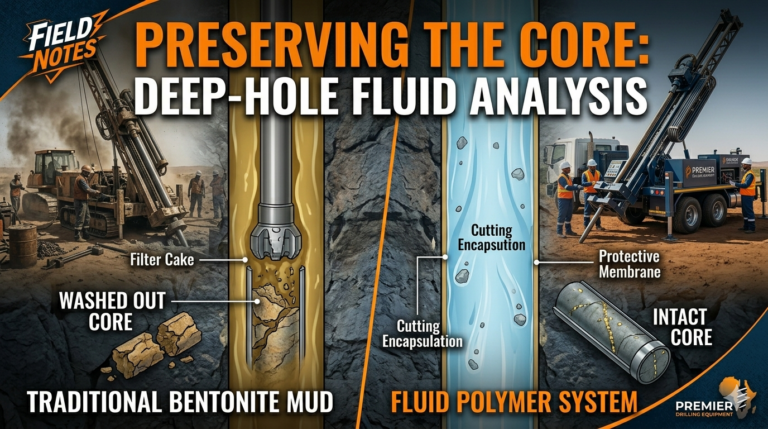
Fluid management stabilises the borehole and supports core transport.
In fractured zones:
- Viscosity must be consistent
- Polymer balance must be controlled
- Circulation must remain steady
Insufficient fluid support increases wall collapse risk. Over-aggressive flushing can wash away fines and reduce recovery.
Fluid control is critical to fractured ground drilling.
Core Barrel Configuration
Barrel setup influences retention.
Shorter runs in highly fractured intervals reduce internal core grinding.
Inner tube condition, landing ring wear, and latch function should be inspected frequently.
Incorrect barrel configuration contributes directly to core loss.
Monitor Torque and Vibration Trends
Broken formation drilling produces mechanical warnings before recovery collapses.
Operators should monitor:
- Torque fluctuations
- Increased vibration
- Sudden resistance changes
- Irregular penetration rates
Early adjustments prevent escalating core loss.
Core drilling performance optimisation depends on continuous monitoring.
Tooling and Rig Selection Influence Recovery
Tooling suitability affects mechanical stability.
Using correctly specified consumable core drilling products reduces premature wear and improves consistency in fractured formations.
When unstable surface or shallow ground conditions demand controlled precision, geotechnical drill rigs provide improved alignment and stability compared to forcing inappropriate configurations.
In underground environments, correctly matched underground drill rigs improve positioning, access efficiency, and operational stability in confined spaces.
Mechanical suitability influences recovery more than initial equipment price.
Reduce Re-Drilling Through Structured Field Logging
Field documentation transforms performance.
Operators should log:
- Recovery percentage per run
- Lithology transitions
- RPM and feed adjustments
- Torque behavior
- Fluid adjustments
- Non-productive time related to formation instability
Patterns become visible when logged consistently.
Structured logging allows proactive parameter adjustment rather than reactive correction after recovery declines.
Programs that document rigorously reduce re-drilling over time.
The African Operational Context
Fractured ground drilling in Africa introduces additional exposure.
Remote supply chains delay component replacement. Water access may be limited. Emergency freight is costly and slow.
When fractured zones cause unexpected wear or failure, rapid replacement is rarely available.
This increases the importance of preventive mechanical discipline.
In remote conditions, fractured ground must be controlled before it escalates. There is rarely immediate external technical support.
Operational self-reliance is essential.
Core Recovery Is Mechanical Discipline
Core recovery in broken formation drilling is not unpredictable.
It is shaped by:
- Formation awareness
- Tool selection
- Controlled rotation and feed
- Fluid discipline
- Mechanical attentiveness
- Structured documentation
To improve core recovery, Africa operations must align geological understanding with mechanical execution.
Recovery is not luck.
It is disciplined control under variable conditions.
Programs that treat fractured ground as a structured mechanical challenge protect geological confidence, reduce re-drilling, and stabilise drilling cost per meter.
Frequently Asked Questions
What causes poor core recovery in fractured ground?
Highly jointed or weathered formations combined with excessive RPM, aggressive feed pressure, and incorrect bit selection are common causes.
How can drilling parameters improve recovery?
Reducing rotation speed, controlling feed pressure, and responding to torque fluctuations improve core integrity.
Does tooling selection affect recovery?
Yes. Bit matrix, reaming shell condition, and barrel configuration directly influence recovery outcomes.
Why is core recovery critical for exploration programs?
Low recovery reduces geological confidence and often requires confirmation drilling, increasing program duration and overall cost.