The ROI of Mobile Drill Rigs in Greenfield Exploration: Reducing Rig-Up Time in Harsh Terrains
In greenfield mineral exploration, time spent non-drilling is capital bled. For exploration managers and project geologists operating across the remote, infrastructure-poor regions of Sub-Saharan Africa, the true cost of an exploration programme is not merely the price per metre of core pulled; it is heavily dictated by the efficiency of moving between targets.
When utilizing traditional, heavy static setups or unmotorized skid-mounted systems, “blind time”—the hours or days spent clearing massive pads, towing equipment through thick bush, and executing complex mechanical rig-ups—can severely diminish a project’s budget. To maximize the return on investment (ROI) of exploration capital, progressive campaigns are increasingly pivoting toward agile, self-contained Mobile Drill Rigs.
By evaluating the engineering behind mobility, mechanical setup times can be compressed, operational overheads reduced, and more capital directed where it belongs: into the core tray.
The Anatomy of Rig-Up Efficiency
Traditional Surface Drill Rigs are highly effective for deep, long-range target definition, but their weight and structural footprint require extensive logistics during multi-station, early-stage greenfield campaigns. A standard rig move often requires secondary support fleets—such as flatbed trucks, cranes, or heavy bulldozers—to load, transport, unload, and position the asset.
In contrast, modern mobile configurations integrate the carrier, power pack, and mast assembly into a single, self-propelled unit. The mechanical advantages that eliminate logistical bottlenecks include:
- Integrated Hydraulic Mast Assemblies: Eliminates the need for external crane deployment or complex manual pin-and-pulley rigging. The mast is raised and locked into position hydraulically within minutes of arriving at the stake.
- Heavy-Duty Hydraulic Leveling Jacks: Standardizes the stabilization process. Instead of spending hours constructing elaborate timber cribbing or grading perfectly level earth pads, the operator can level the chassis rapidly via independent hydraulic outriggers, even on uneven, sloped ground.
- On-Board Auxiliary Systems: By mounting mud pumps, rod racks, and wireline winches directly onto the mobile platform, the entire primary drilling setup moves as a single cohesive ecosystem, omitting the time required to manually spot and connect auxiliary support equipment.
Navigating the Logistical Realities of African Terrains
Greenfield exploration in Africa rarely happens near a paved road. Whether navigating the deep, energy-sapping sands of the Kalahari, traversing the wet, high-plasticity clays of the Central African copperbelts, or climbing the rugged, un-roaded escarpments of remote greenstone belts, transport is a major cause of mechanical wear-and-tear.
When a traditional rig is subjected to hours of severe torsional stress while being towed over rough terrain, it frequently arrives at the next drill site requiring structural or hydraulic maintenance before drilling can even commence.
Highly mobile track-mounted or ruggedized all-wheel-drive truck-mounted units are engineered specifically to absorb these transit dynamics. High ground clearance, robust suspension articulation, and high-torque low-range drivetrains mean these units navigate challenging terrains under their own power. Mobility is not just about cross-country speed; it is about arriving at the next drill pad structurally intact and ready to rotate the string immediately.
Calculating the True ROI of Mobility
To justify the deployment of a mobile fleet architecture, project directors must look beyond the initial asset acquisition cost and calculate the holistic operational savings across a multi-hole campaign.
Time-to-First-Core (Compressed Pad Moves)
Consider a standard 30-hole greenfield grid where the rig must move every 200 metres. If a conventional setup requires 12 hours to tear down, move, spot, level, and rig up, the campaign incurs 360 hours of non-drilling operational costs. A highly optimized mobile unit can often break down and rig up on an adjacent pad in under 2 hours. By saving 10 hours per move, the project reclaims 300 operational hours—equivalent to weeks of extra production time within the same budgetary window.
Asset and Personnel Mitigation
Because mobile units are self-propelled and self-contained, the reliance on external support assets drops dramatically. Projects no longer need to maintain dedicated tracking dozers or contract external crane trucks just to facilitate pad transitions. Furthermore, smaller, highly automated mobile crews reduce camp overheads, fuel burn, and safety exposure during complex lifting and loading sequences.
Civil and Environmental footprint reduction
Traditional heavy setups demand large, flat, cleared drill pads to accommodate support vehicles and structural configurations. In ecologically sensitive or heavily regulated zones, large pads increase civil earthworks costs and balloon eventual environmental rehabilitation liabilities. Mobile units require a fraction of the physical clearing, leaving a minimal environmental footprint and drastically lowering post-campaign remediation expenses.
The Support Ecosystem: Ensuring Mechanical Continuity
Achieving an exceptional logistical ROI is irrelevant if the rig stands idle due to downhole component failures. High-mobility rigs must be supported by an equally robust consumable strategy. Once the rig is stabilized and upright, the operational focus shifts instantly to core recovery efficiency.
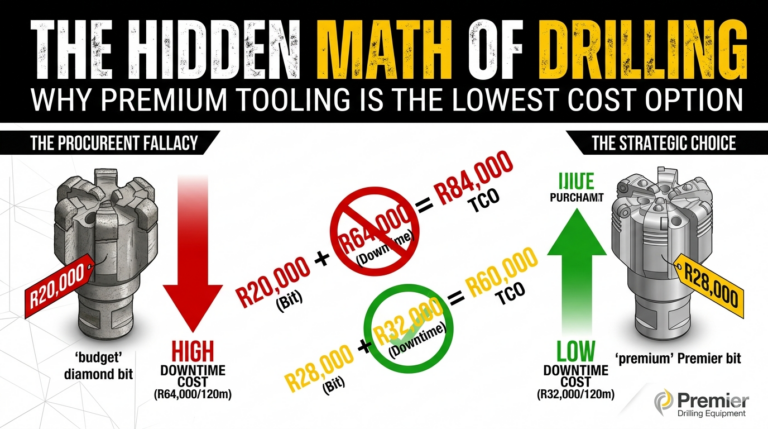
To prevent the gained time from being lost to downhole mechanical failures, operations should be backed by precision-engineered drill rods, reliable wireline core barrels, and application-specific diamond matrix bits. Fast setup speeds must be matched by high penetration rates and durable tools capable of handling variable, un-weathered formations without constant, premature tripping of the string.
Conclusion: Driving Efficiency in the Field
In competitive greenfield exploration, the companies that succeed are those that manage their non-productive time with mathematical precision. While heavy, high-capacity static rigs retain an vital position in deep-hole structural definition, early-to-mid-stage exploration requires a fleet that matches the dynamic pace of the geological team.
Investing in mobile infrastructure drastically compresses rig-up timelines, mitigates environmental footprint liabilities, and cuts out secondary support asset costs. Ultimately, reducing the time spent between holes allows exploration campaigns to prove up resources faster, optimize operational expenditures, and secure a higher return on their field budgets.
To explore further technical field insights regarding rig choice, core recovery optimization, and regional exploration logistics, return to our main Field Notes hub.
Consult with Our Technical Team
Optimizing your greenfield drilling fleet requires matching the right mobility platform with your specific geographical and geological targets. Contact Premier Drilling Equipment today to review detailed mobile rig specifications, discuss asset deployment logistics, or request a custom quotation tailored for harsh African environments.