Water-Scarce Core Drilling: How to Stabilize Holes and Protect Performance in African Mining Conditions
Water is not a guaranteed resource on African mine sites. In many regions, water is trucked in over long distances. In others, boreholes are unreliable or saline. During extended dry seasons, allocation is restricted. At remote exploration camps, every cubic metre of water has a measurable logistics cost attached to it.
Yet core drilling performance depends heavily on proper fluid management.
When water is mismanaged, holes collapse. Core recovery drops. Rods bind. Re-drilling increases. Non-productive time escalates. Cost-per-meter climbs quietly but aggressively.
In water-scarce African mining environments, fluid management is not a secondary consideration. It is a strategic performance lever.
Why Water Management Directly Impacts Cost-Per-Meter
Core drilling economics are often assessed through cost-per-meter metrics. What is less visible is how fluid mismanagement erodes those margins.
Common water-related failure points include:
- Inadequate hole stabilization leading to wall collapse
- Excessive dilution reducing polymer performance
- Poor viscosity control causing inadequate cuttings suspension
- Loss of circulation in fractured zones
- Re-drilling due to unstable formations
Each of these introduces hidden costs:
- Additional bit wear
- Increased rod handling
- Extended drilling time
- Additional fuel consumption
- Delayed geological decision-making
When water must be trucked to site, the cost multiplier becomes even more severe. Every wasted litre represents transport cost, storage handling, and potential downtime if supply chains are disrupted.
In African operations where freight constraints and infrastructure variability are common, fluid optimisation becomes operational insurance.
Understanding Drilling Fluids and Polymers in Hard Rock Conditions
In hard rock and mixed lithology environments, drilling fluids serve several essential functions:
- Stabilising borehole walls
- Suspending and transporting cuttings
- Reducing friction
- Minimising torque and drag
- Assisting in deviation control
Polymers and drilling additives are not simply thickening agents. When correctly selected and mixed, they create controlled filtration and stabilisation characteristics that protect the integrity of the borehole.
In fractured formations, proper polymer selection helps:
- Reduce fluid loss
- Support weak zones
- Improve core recovery
- Maintain consistent drilling rates
In abrasive formations, correct viscosity reduces mechanical strain and protects tooling.
Under African conditions, where formations can vary significantly within a single campaign, fluid programs must adapt quickly. Static, one-size-fits-all fluid approaches are inefficient and risky.
Water Budget Planning for Remote African Sites
Effective drilling in water-scarce environments begins with a water budget.
Key considerations include:
Water Source Type
- Trucked water with defined delivery intervals
- Borehole water with variable flow rates
- Surface water subject to seasonal reduction
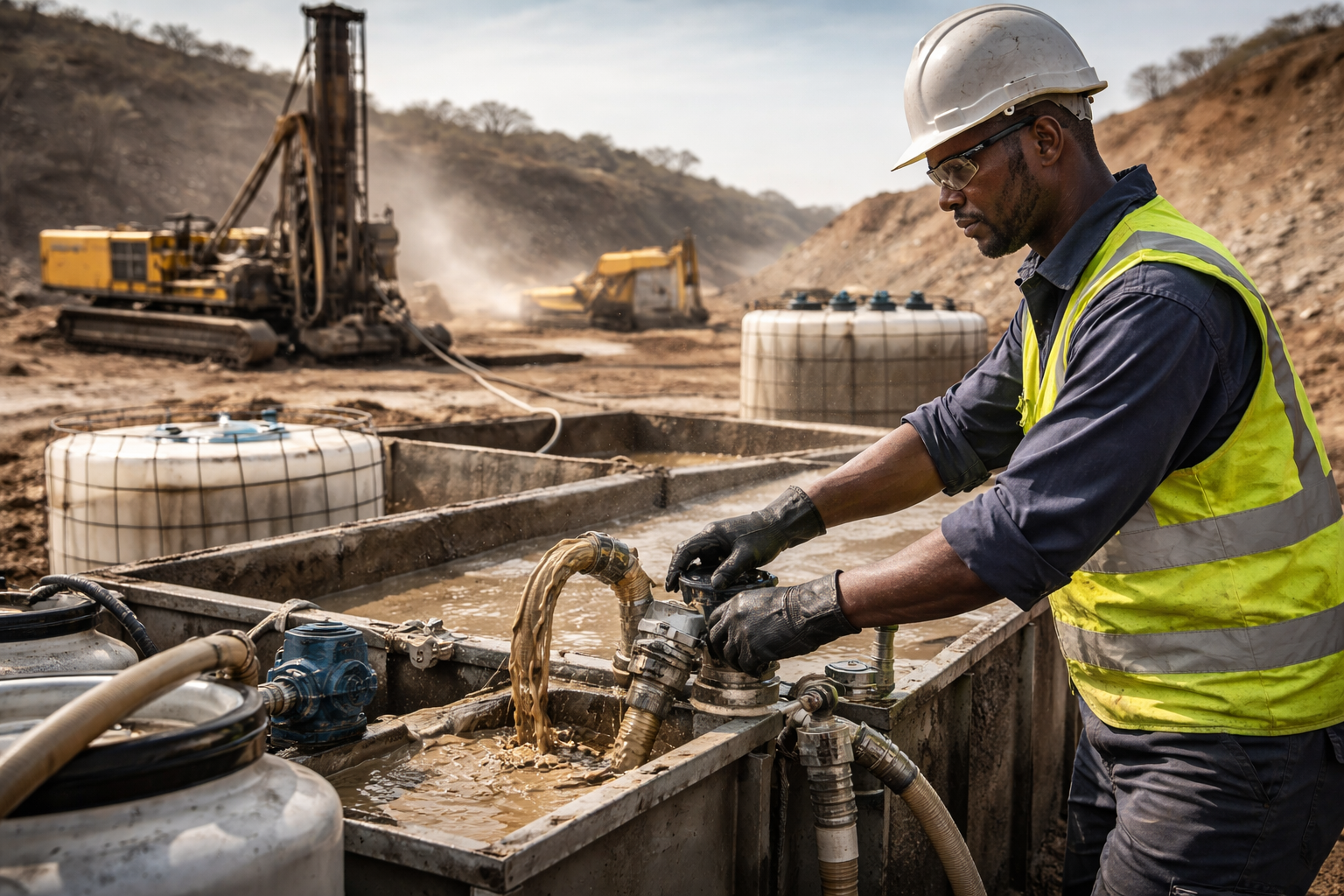
- Recycled water from drilling sumps
Each source carries different reliability risks.
Storage Capacity
Insufficient storage increases vulnerability to supply disruption. Excessive storage without treatment can degrade water quality and polymer effectiveness.
Evaporation Losses
In high-heat regions, evaporation rates can materially impact daily availability. Open storage systems must be evaluated accordingly.
Recycling Potential
Settling pits, filtration systems, and controlled reuse strategies can significantly reduce net consumption. However, recycling must be monitored to prevent contamination and performance degradation.
A structured water plan allows drilling teams to:
- Forecast daily consumption per meter drilled
- Adjust fluid concentration strategically
- Avoid emergency trucking costs
- Protect hole stability during supply fluctuations
Operational Playbook: Reducing Water Consumption Without Sacrificing Performance
Reducing water consumption does not mean underperforming. It means optimising intelligently.
Polymer Optimisation
Proper dosing prevents overuse. Over-concentration increases cost. Under-dosing reduces stability. Calibration matters.
Controlled Mixing Procedures
Untrained mixing introduces inconsistency. Standardised mixing protocols ensure predictable viscosity and filtration behaviour.
Crew Training
Operators must understand:
- Why viscosity matters
- How to identify unstable conditions early
- When to adjust fluid concentration
- How to monitor return flow quality
High crew turnover in some African regions makes structured training essential.
Monitoring and Documentation
Regular measurement of:
- Fluid density
- Viscosity
- Flow rates
- Loss circulation events
Allows proactive adjustment rather than reactive correction.
When fluid management becomes systematic rather than reactive, water consumption drops while performance stabilises.
Geotechnical Drilling in Water-Constrained Environments
Water management becomes even more critical in geotechnical investigations, where hole integrity and data reliability directly influence engineering decisions.
Projects involving infrastructure stability, tailings facilities, plant foundations, and access roads require precision and controlled drilling conditions. In such cases, selecting appropriate geotechnical drill rigs is as important as fluid selection.
Proper rig configuration, controlled feed pressure, and fluid management work together to:
- Maintain borehole geometry
- Protect sampling integrity
- Reduce disturbance in soft ground
- Minimise environmental impact
Geotechnical drilling under water constraints demands both equipment alignment and disciplined fluid strategy.
ESG, Environmental Discipline and Water Governance
Modern mining operations operate under increased environmental scrutiny. Water stewardship is no longer optional.
Drilling fluid management intersects with environmental responsibility in several ways:
- Spill prevention protocols
- Controlled discharge and containment
- Protection of nearby watercourses
- Responsible additive selection
- Reduction of unnecessary water extraction
In regions sensitive to tailings governance and environmental regulation, documented water discipline strengthens compliance positioning.
Environmental discipline also protects operational continuity. Incidents trigger inspections. Inspections slow projects.
Structured water management reduces that risk.
African Realities: Infrastructure and Logistics Constraints
Southern African operations frequently contend with:
- Freight bottlenecks
- Border clearance delays
- Energy supply instability
- Remote camp access challenges
Water trucking can be disrupted by infrastructure constraints. Borehole pumps may fail during energy outages. Seasonal rains may cut off access routes.
When drilling operations are already operating at narrow margins, reliance on unstable water supply systems creates compounded risk.
Fluid efficiency becomes a resilience strategy.
Positioning Fluid Strategy as a Performance Tool
In water-scarce African mining environments, drilling fluids should be treated as performance assets rather than consumables.
Strategic fluid management delivers:
- Reduced non-productive time
- Improved core recovery
- Lower re-drill rates
- More predictable cost-per-meter
- Improved environmental positioning
Drilling contractors and mine managers who formalise water strategy outperform those who treat it as secondary.
Premier Drilling Equipment aligns equipment capability, consumables selection, and operational guidance to ensure that water constraints do not dictate performance outcomes.
In environments where every resource must be managed precisely, water strategy becomes a competitive advantage.
Conclusion
Water scarcity across African mining operations is not an abstract risk. It is an operational reality.
Core drilling performance depends on fluid discipline, equipment alignment, crew competency, and structured planning. When water is limited, every inefficiency multiplies cost.
By implementing structured water budgeting, intelligent polymer selection, controlled mixing protocols, and disciplined monitoring, mines can stabilise boreholes, protect performance, and reduce cost-per-meter.
Water is a strategic asset. Drilling operations that manage it deliberately outperform those that manage it reactively.
Frequently Asked Questions
Why is water management critical in African drilling operations?
Water is often trucked or sourced from limited boreholes. Mismanagement increases cost, downtime, and hole instability, directly impacting cost-per-meter.
Can polymer drilling additives reduce water consumption?
Yes. Properly selected and mixed polymers stabilise holes and improve cuttings suspension, reducing the need for excessive water use and re-drilling.
How does water scarcity affect geotechnical investigations?
Unstable holes compromise sampling accuracy and data integrity. Controlled fluid programs and properly configured rigs are essential for reliable geotechnical outcomes.
What is the biggest mistake in fluid management?
Inconsistent mixing and poor monitoring. Without structured measurement of viscosity and density, performance becomes unpredictable.
Does water recycling reduce performance?
When managed correctly with proper settling and filtration, recycling can reduce consumption without sacrificing drilling efficiency.