Beyond the Bit – How Tooling Precision Protects Your Geological Data
In mineral exploration, the drill rig is often viewed as a machine for making holes. But for the Exploration Manager and the Project Geologist, the rig is actually a high-precision data harvesting tool. The “product” isn’t the borehole; it’s the cylinder of rock that comes out of it.
The most expensive centimetre of drilling isn’t the one that takes the longest to cut—it’s the one that is lost, ground to powder, or contaminated due to mechanical failure. When you are drilling a high-grade intersection at 500 metres, the difference between a “Resource” and a “Waste” classification often comes down to the integrity of your core lifters and inner tubes.
At Premier Drilling Equipment, we understand that our tools don’t just face the rock; they protect your data.
The Geologist’s Nightmare: Mechanical Core Loss
Imagine a scenario where your drilling team hits a zone of friable, high-grade gold mineralisation. The geologist is expecting a 100% recovery. Instead, the inner tube is pulled, and half the sample is missing—ground into a fine paste by the rotation of the bit.
This is mechanical core loss, and it is almost always caused by inferior tooling. If a core lifter fails to “grip” or if the inner tube has a slight eccentricity (a “wobble”), the core begins to spin inside the tube. Once the core starts spinning, it acts as an abrasive against itself, destroying the very structures the geologist needs to map.
The Physics of the Sample: Straightness and Hardening
To prevent core destruction, two technical factors are non-negotiable:
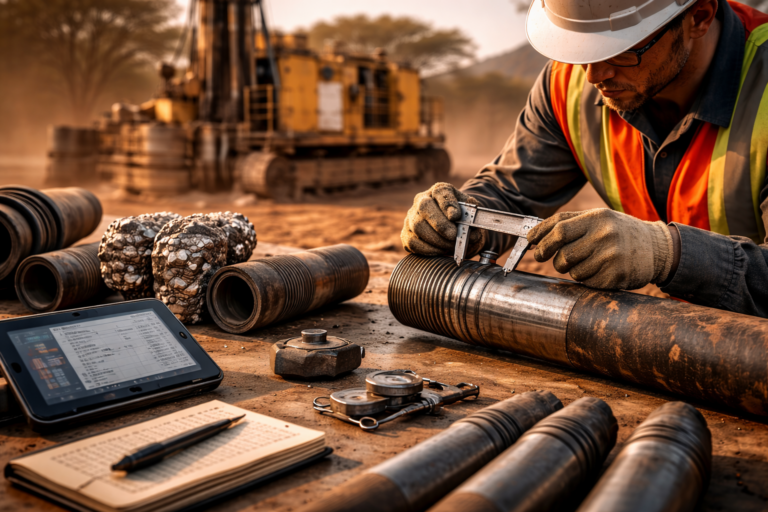
- Inner Tube Straightness: A budget inner tube often has a slight longitudinal bow. At high RPMs, this bow creates a centrifugal “whip” that hammers the core against the tube wall. Premier’s inner tubes are manufactured to strict straightness tolerances, ensuring the sample remains stationary and protected from the moment it enters the barrel.
- Core Lifter Case-Hardening: The core lifter is the primary mechanical interface between the rock and the rig. If the “teeth” of the lifter round off because the metal is too soft, the core will slip. Our lifters undergo a specific case-hardening process that maintains a sharp, aggressive profile even in the most abrasive South African formations, ensuring a positive “break” and secure retention.
Compliance, Confidence, and the Resource Statement
For Tier-1 mining houses and junior explorers alike, Core Recovery Percentage is a key metric for SAMREC or JORC compliance. If your recovery is consistently low, the confidence level of your Mineral Resource Statement is compromised. This can lead to “penalties” in your grade estimation or, in extreme cases, the requirement to re-drill entire sections of the programme.
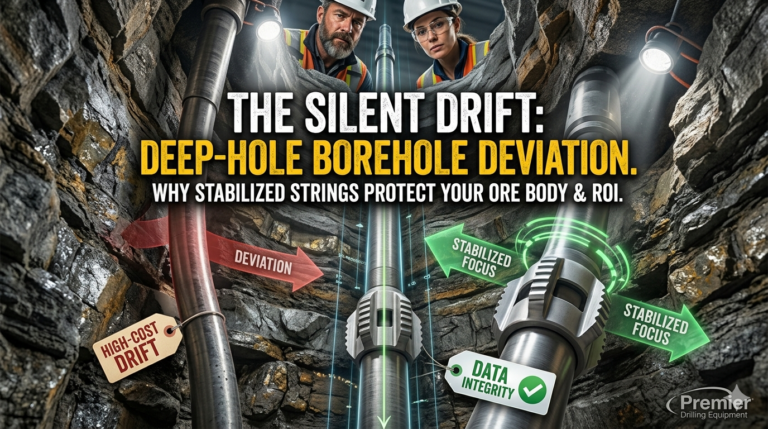
Using premium consumables is an investment in Data Integrity. When the geology reaches the lab intact, with original bedding planes and mineral structures preserved, the geologist can sign off on the data with absolute confidence.
Field Note: Identifying “Core Spinning”
Before you blame the formation for poor recovery, check the core for these “Spinning” signatures:
- Circular Grooving: Look for perfectly circular wear marks on the outside of the core cylinder.
- “Button” Ends: If the ends of the core pieces are rounded or polished like buttons, the core has been rotating against itself.
- The Fix: Check your inner tube gap. If the gap between the bit and the inner tube is too large, it allows “washout” and movement. Adjust the landing shoulder or replace worn core lifter cases immediately.
Conclusion: The Guardian of the Geology
At Premier Drilling Equipment, we don’t just measure our success by how many metres our bits can cut. We measure it by the quality of the core sitting in your trays.
By prioritizing the metallurgy of our lifters and the straightness of our tubes, we act as the final line of defence for your geological data. We ensure that the value you find in the ground is the same value that makes it to the assay lab.