Drill Rod Metallurgy Explained: Why Steel Grade and Heat Treatment Determine Failure Rates
Drill rod failure is often described as “bad luck.”
A snapped rod.
A stripped thread.
An unexpected string retrieval.
In reality, most drill rod failures are not random. They are metallurgical.
Procurement decisions frequently focus on diameter, length, connection type, and price. Yet beneath those visible specifications lies the determining factor in fatigue resistance and service life:
Steel chemistry and heat treatment.
Understanding 4130 drill rod metallurgy — and how it differs from lower-grade alternatives — is central to controlling failure rates, protecting thread integrity, and stabilising cost-per-metre in demanding drilling environments.
This Field Notes deep dive examines why material science, not just geometry, determines drill rod reliability.
Not All Drill Rod Steel Is Equal
From the outside, two drill rods may appear identical.
Same dimensions.
Same thread form.
Same nominal strength rating.
Yet under cyclic torque and bending stress, one may endure thousands of cycles longer than the other.
The difference is metallurgy.
Drill rods operate in a high-cycle fatigue environment:
- Repeated torque loading
- Make-and-break cycles
- Bending stress from hole deviation
- Vibration-induced microloading
- Impact during handling
In this environment, steel quality determines whether stress is absorbed elastically or transformed into microcrack propagation.
4130 drill rod metallurgy provides measurable advantages in this context — when properly processed.
What Is 4130 Steel?
4130 is a chromium-molybdenum alloy steel commonly referred to as “chromoly.”
Its approximate composition includes:
- ~0.30% carbon
- Chromium for hardenability and wear resistance
- Molybdenum for strength retention at elevated temperatures
- Balanced manganese content
This alloy composition delivers:
- Higher tensile strength than mild steel
- Improved fatigue resistance
- Better toughness-to-weight ratio
- Enhanced hardenability during heat treatment
In drilling applications, these properties matter because rods must withstand:
- Repeated torsional loading
- Bending stress
- Surface wear at threaded connections
Lower-grade carbon steels may meet minimum static strength requirements, but fatigue performance differs significantly.
4130 drill rod metallurgy is not simply stronger — it is engineered for cyclic endurance.
Heat Treatment: The Hidden Determinant
Alloy composition alone does not guarantee performance.
Heat treatment defines the final microstructure — and therefore real-world behaviour.
Common processes include:
- Normalising
- Quenching
- Tempering
When properly controlled, these processes balance:
- Surface hardness
- Core ductility
- Yield strength
- Fracture toughness
Why Heat Treatment Matters
If heat treatment is insufficient:
- Threads may deform plastically under torque
- Surface hardness may be inadequate
- Fatigue resistance declines
If heat treatment is excessive or inconsistent:
- Brittleness increases
- Microcracks form under cyclic load
- Sudden fracture becomes more likely
4130 drill rod metallurgy is only as reliable as its heat treatment control.
Inconsistent batch processing produces rods that may pass dimensional inspection but fail prematurely under field stress.
Thread Deformation Patterns
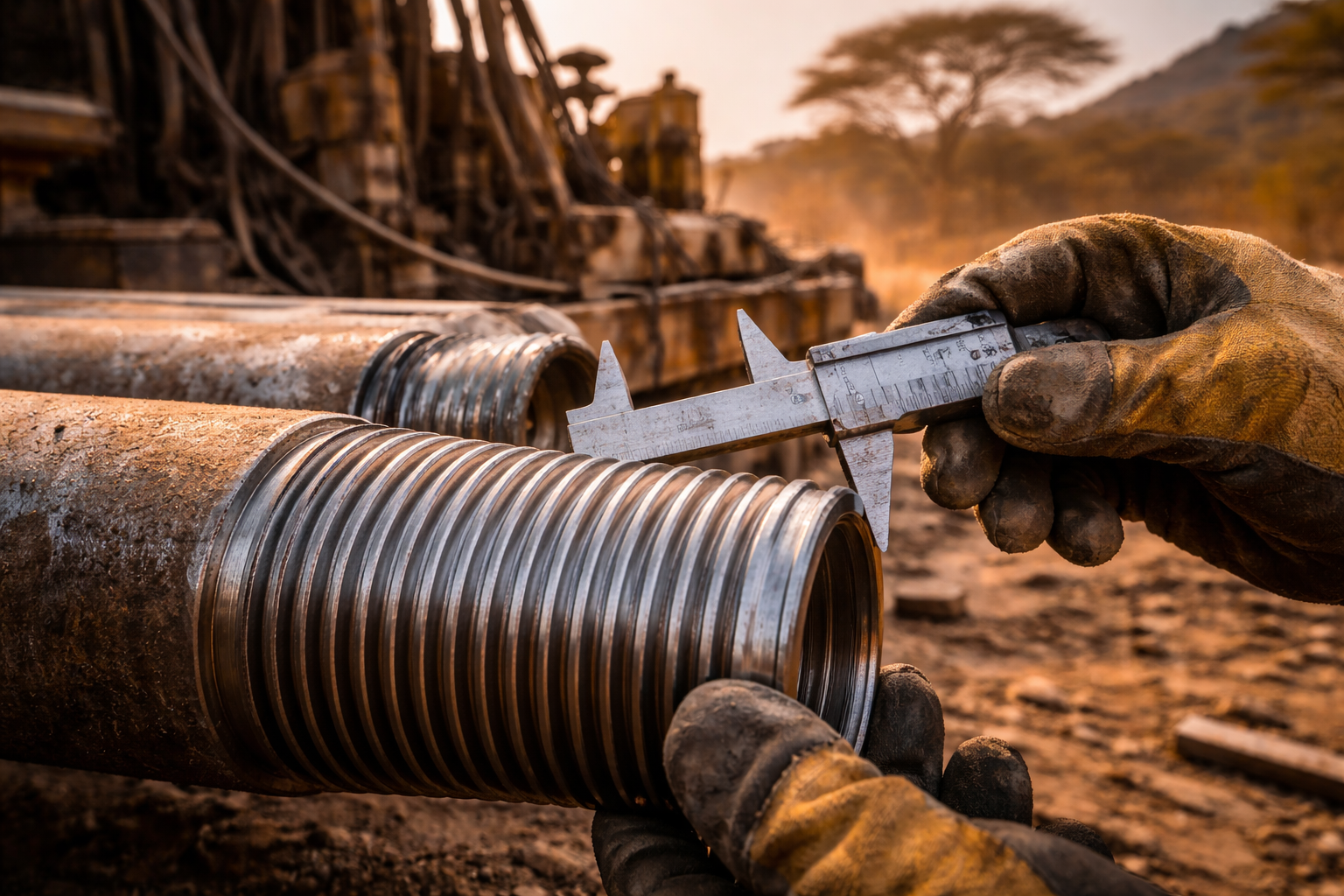
Thread integrity is often the first visible sign of metallurgical quality.
Under repeated make-and-break cycles and torsional load, inferior steel exhibits:
- Crest rounding
- Root tearing
- Surface galling
- Engagement depth reduction
These deformation patterns indicate plastic flow — the steel is yielding beyond its elastic limit.
In properly heat-treated 4130 drill rod metallurgy:
- Thread form retains geometry longer
- Surface hardness resists galling
- Deformation occurs more gradually
Thread damage is rarely only a machining issue.
It is often a material behaviour issue.
As explored in Thread Damage & Rod Failure, surface wear patterns reflect underlying metallurgical discipline.
Microfracture Propagation: The Hidden Failure Process
Drill rods rarely fail in a single event.
Failure follows a predictable fatigue sequence:
- Stress concentration forms at a thread root or surface defect
- A microcrack initiates
- Repeated cyclic loading extends the crack
- Cross-sectional area reduces
- Final catastrophic fracture occurs
The speed of crack propagation depends heavily on:
- Alloy composition
- Heat treatment quality
- Residual stress management
- Surface finish
Properly processed 4130 drill rod metallurgy resists crack initiation longer and slows crack growth under cyclic stress.
Lower-grade steels accelerate the fatigue curve.
In high-cycle drilling applications, even small differences in crack resistance translate into measurable lifecycle differences.
Metallurgical Fatigue Cycles in Drilling
Drilling is not static loading. It is dynamic, high-cycle fatigue loading.
Each drilling cycle imposes:
- Torsional stress
- Axial tension/compression
- Bending stress from hole deviation
- Vibrational microstress
Hole deviation amplifies bending stress, introducing asymmetric loading on the drill string.
This increases fatigue intensity at:
- Thread roots
- Shoulder transitions
- Heat-affected zones
High-quality 4130 drill rod metallurgy provides better resilience to this cyclic stress profile.
When deviation increases bending loads — as discussed in Hole Deviation — inferior metallurgy shortens fatigue life disproportionately.
Fatigue failure is not immediate.
It accumulates.
Material quality determines accumulation rate.
The Role of Surface Hardness and Core Toughness
An effective drill rod must balance:
- Hard surface resistance to wear
- Tough core resistance to fracture
Overly soft surface:
- Rapid thread deformation
- Accelerated wear
Overly hard but brittle structure:
- Crack propagation under impact
- Sudden fracture
Controlled tempering of 4130 achieves a balance between these extremes.
Heat treatment precision separates engineering-grade rods from low-cost substitutes.
Storage and Environmental Impact
Even high-quality 4130 drill rod metallurgy can be compromised by poor storage.
Environmental exposure introduces:
- Corrosion pitting
- Surface oxidation
- Microstructural weakening
- Hydrogen embrittlement risk in extreme cases
Corrosion pits act as stress concentrators — ideal initiation sites for fatigue cracks.
Proper storage discipline includes:
- Dry covered storage
- Thread protectors
- Moisture control
- FIFO rotation
As discussed in Consumables Lifecycle Engineering, storage conditions directly affect lifespan.
Metallurgy sets potential performance.
Storage discipline preserves it.
Metallurgy and Cost-Per-Metre Stability
Material choice influences more than durability.
If rod failure frequency increases by even 5–10%:
- String retrieval time increases
- Non-productive time rises
- Replacement freight may be required
- Adjacent rods may suffer secondary damage
- Schedule compression introduces parameter stress
These factors increase cost-per-metre beyond the visible component price difference.
Inferior metallurgy may reduce upfront purchase cost.
But lifecycle cost increases.
4130 drill rod metallurgy, when properly processed, supports predictable fatigue performance — and therefore predictable economics.
How to Evaluate Drill Rod Quality
Procurement should include metallurgical verification, not just dimensional confirmation.
Key evaluation factors:
- Material certification documentation
- Batch traceability
- Heat treatment specification
- Hardness testing data
- Surface inspection standards
- Thread machining precision
- Consistency across batches
Ask:
- What is the exact alloy specification?
- What is the tempering range?
- Is hardness uniform across batches?
- Is there traceability to heat numbers?
Engineering-grade procurement reduces long-term failure risk.
Metallurgy vs Marketing Claims
“High strength steel” is not a specification.
“Chromoly” without heat treatment documentation is incomplete.
True 4130 drill rod metallurgy requires:
- Controlled alloy chemistry
- Precision heat treatment
- Surface finish quality
- Dimensional accuracy
- Consistent process control
Failure rates are often the result of uncontrolled variables — not bad luck.
Field Reality in Harsh Environments
African drilling conditions introduce additional stress factors:
- Abrasive geology
- Temperature extremes
- Remote logistics
- Handling damage during transport
- Inconsistent operator torque discipline
These amplify metallurgical weaknesses.
Higher fatigue resistance becomes more valuable as environmental stress increases.
Material discipline supports operational resilience.
Field Notes Close
Drill rod failure is rarely accidental.
It reflects:
- Alloy choice
- Heat treatment control
- Fatigue resistance
- Thread integrity
- Storage discipline
4130 drill rod metallurgy offers structural advantages in cyclic drilling environments — when processed correctly.
Steel chemistry matters.
Heat treatment matters more.
Fatigue is predictable.
Before selecting drill rods based solely on price or appearance, evaluate the metallurgy beneath the surface.
Because cost-per-metre stability begins at the atomic level.
Frequently Asked Questions
1. What is 4130 drill rod metallurgy?
4130 drill rod metallurgy refers to the use of chromium-molybdenum alloy steel with controlled heat treatment to enhance fatigue resistance, strength, and durability under cyclic drilling loads.
2. Why is heat treatment important for drill rods?
Heat treatment defines hardness, toughness, and fatigue performance. Improper heat treatment can result in brittle fracture or excessive thread deformation under load.
3. How do drill rods fail from fatigue?
Fatigue failure begins with microcracks at stress concentrations (often thread roots), which grow progressively under cyclic torque and bending until catastrophic fracture occurs.
4. What causes thread deformation?
Thread deformation is caused by plastic yielding under repeated torque, often accelerated by insufficient surface hardness or inferior steel grade.
5. Does storage affect drill rod lifespan?
Yes. Corrosion, moisture exposure, and improper handling introduce stress concentrators that accelerate fatigue crack initiation and reduce effective service life.