Calculating True Cost Per Meter: How 1541/4130 Steel Drill Rods Impact Unit-Level Economics
In the high-stakes environment of mineral exploration across Africa’s most demanding geologies, procurement decisions are often driven by surface-level metrics. The initial purchase price of drilling consumables is easily quantified on a balance sheet. However, for exploration managers and site geologists operating in deep penetration scenarios, optimizing the upfront cost of a drill rod often creates a dangerous illusion of savings.
To build a genuinely profitable exploration campaign, drilling operations must pivot from basic expense tracking to rigorous unit-level digital costing. By calculating the True Cost Per Meter (TCPM), we can accurately measure how the metallurgical integrity of your Core Drilling Equipment dictates the financial trajectory of the entire project.
At the center of this economic model is the drill string itself. When you evaluate the operational lifespan, vibration resistance, and structural reliability of MBI Global drill rods forged from high-grade 1541/4130 steel, it becomes clear that investing in premium tensile strength is not merely an engineering choice—it is a foundational driver of your Gross Margin Return on Investment (GMROI).
The Mechanics of Failure in Deep Penetration Scenarios
Every meter drilled exponentially increases the kinetic and rotational stress transferred through the drill string. In fractured rock zones or highly abrasive granite, substandard rods succumb to three primary modes of failure, each carrying catastrophic economic penalties.
1. Accelerated Thread Wear
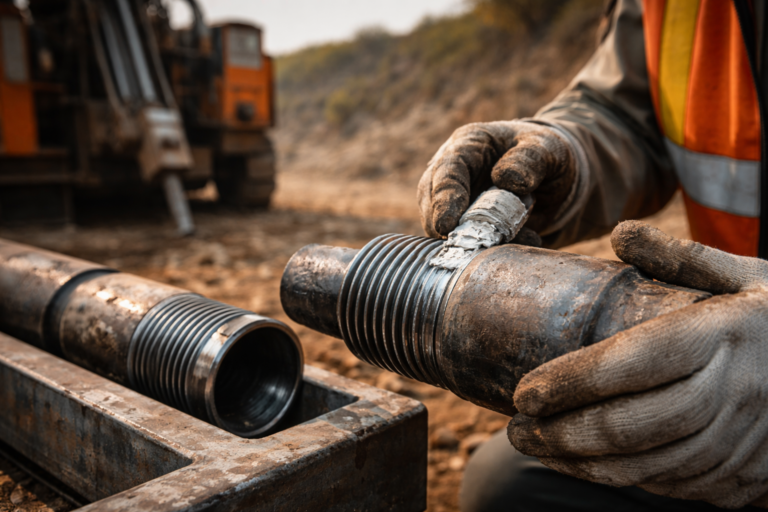
The thread joints are the most vulnerable points in any core drilling operation. During continuous make-up and break-out cycles, inferior steel degrades rapidly. Micro-abrasions compound into severe thread galling, compromising the torque transfer. When threads wear prematurely, the rod must be tripped out and discarded, instantly driving up the consumable cost per meter and halting core sample recovery.
2. Catastrophic Joint Failure
In deep boreholes, the hydrostatic pressure and rotational torque require absolute precision. If the steel lacks sufficient yield strength, the box or pin end of the rod can shear entirely. Joint failure downhole is a worst-case scenario; it necessitates immediate fishing operations. The cost of a snapped rod is negligible compared to the hundreds of thousands of Rands lost in idle rig time, crew wages, and potentially abandoned boreholes.
3. Harmonic Vibration Fatigue
High-speed diamond drilling generates intense, continuous vibrations. Standard carbon steel absorbs this kinetic energy poorly, leading to metal fatigue and micro-fracturing along the rod body. Over time, this harmonic stress causes bowing, reducing penetration rates and causing excessive wear on diamond bits and core barrels.
The Metallurgical Advantage: 1541 and 4130 Steel
To counteract these failures, MBI Global engineers its drill rods utilizing precision heat-treated 1541/4130 steel. This metallurgical composition fundamentally alters the durability of the equipment.
- 1541 Carbon-Manganese Steel: Known for its deep hardenability, 1541 steel provides an exceptional balance of surface hardness and core toughness. This specific grade drastically reduces thread wear during repetitive handling, ensuring that the precision-machined joints maintain their integrity over hundreds of cycles.
- 4130 Chromoly Steel: For applications requiring extreme stress resistance, 4130 chromium-molybdenum steel offers superior tensile strength and fatigue resistance. It absorbs harmonic vibrations without succumbing to micro-fracturing, allowing the rod to maintain its concentricity at depth.
By utilizing these high-grade materials, the drill string acts as a cohesive, resilient system rather than a chain of potential failure points.
Translating Metallurgy into Unit-Level Costing
To understand the financial impact of these metallurgical properties, we must model the unit-level economics of the drilling operation.
Traditional costing often looks like this: Total Rod Cost / Expected Meters = Basic Cost Per Meter
Unit-level digital costing, however, demands that we account for operational friction and downtime. The formula for True Cost Per Meter (TCPM) must factor in the hourly burn rate of the rig when it is not cutting rock:
TCPM = (Total Consumable Cost + (Downtime Hours × Hourly Rig Operating Cost)) / Total Meters Drilled
When you model the economics using this framework, the higher upfront cost of 1541/4130 steel is rapidly amortized. A cheaper rod might save 15% on the purchase order, but if its lower tensile strength results in thread galling that forces an extra trip out of the hole—or worse, a fishing job—the operational downtime instantly destroys any perceived savings.
Driving GMROI with MBI Global Core Drilling Equipment
Gross Margin Return on Investment (GMROI) is the ultimate metric for inventory profitability. In mineral exploration, your inventory is the meterage you successfully drill and the core you recover.
Maximizing GMROI requires maximizing the time the bit is at the bottom of the hole cutting rock. Every disruption to the drilling cycle negatively impacts this ratio. By standardizing your operation with MBI Global drill rods, you are effectively buying insurance against downtime.
The unmatched durability of 1541/4130 steel ensures seamless connections, efficient torque transfer, and uninterrupted core sample recovery. It allows exploration managers to accurately forecast shift outputs without building massive contingency buffers for equipment failure.
In the rugged, high-stakes environments of African mineral exploration, profitability is engineered. It begins with acknowledging