Thread Damage & Rod Failure: Early Warning Signs Most Crews Miss
A drilling program can run smoothly for weeks.
Penetration rates are consistent. Recovery is stable. The crew settles into rhythm. Then one rod joint begins to “feel tight” on makeup. The driller notices a slight increase in torque. Nothing dramatic. The shift continues.
Two days later, a connection binds during the breakout. Threads show shiny high spots. The joint is forced back into the string to finish the hole.
By the end of the week, half a shift is lost to a stuck rod and damaged connection. The string must be pulled and inspected. Production drops. Cost-per-meter rises.
Thread damage is rarely sudden. It is progressive and predictable.
Drill rod thread damage begins as a small mechanical signal. When ignored, it becomes a downtime event.
Why Thread Damage Becomes a Cost-Per-Meter Problem
A single damaged connection affects more than one rod.
When threads deform or gall:
- Makeup time increases
- Breakout resistance increases
- Torque consistency drops
- Vibration transfers unevenly along the string
- Adjacent connections experience abnormal load
The immediate impact is non-productive time. The secondary impact is accelerated wear across the entire string.
If a connection fails, consequences escalate:
- Stuck string risk
- Fishing operations
- Twist-off events
- Premature rod replacement
- Increased consumable cost
Reduction in drilling downtime depends heavily on connection integrity. A poorly maintained string quietly increases operating cost per meter long before a visible failure occurs.
The Main Failure Modes
Understanding how connections fail allows crews to intervene early.
Thread Galling
Thread galling occurs when metal transfers between mating surfaces due to friction and inadequate lubrication.
Early signs include:
- Shiny or smeared metal on thread faces
- Rough feel during makeup
- Increased resistance before final torque
If ignored, galling progresses rapidly. Threads lose profile integrity. Load distribution becomes uneven. Eventually, the connection seizes or strips.
Galling is one of the most common contributors to drill rod thread damage in high-cycle operations.
Cross-Threading
Cross-threading typically happens during rushed makeup or misalignment.
It often begins with:
- A connection that does not start smoothly
- An uneven initial turn
- Slight angular misalignment
Operators sometimes force the joint rather than backing off and re-aligning.
The result isa damaged thread profile and weakened load-bearing surfaces. Even if the joint appears usable, its structural integrity has been compromised.
Over-Torque and Under-Torque
Torque discipline is frequently misunderstood.
Over-torque:
- Stresses the thread roots
- Accelerates fatigue
- Increases galling risk
Under-torque:
- Allows micro-movement
- Causes fretting
- Creates uneven wear patterns
Both conditions shorten rod life. Consistency matters more than maximum torque.
Corrosion and Storage Damage
In coastal or humid African environments, improper storage accelerates corrosion.
Contributing factors include:
- Storing rods directly on wet ground
- Missing thread protectors
- Exposure to rain during the wet season
- Poor cleaning before storage
Corrosion weakens thread geometry and promotes galling under load.
Preventative maintenance drilling practices must include storage discipline.
Bending and Fatigue
Thread damage is not always visible at the thread face.
Misalignment, vibration, and excessive dogleg conditions create bending stress in the rod body. Micro-cracks form near the thread roots. Over time, fatigue failure becomes likely.
Early warning signs include:
- Slight wobble during rotation
- Recurring torque spikes
- Visible wear patterns on one side of the thread
Ignoring these signs increases twist-off risk.
Root Causes Most Sites Miss
Many failures are attributed to “bad rods.” In reality, root causes are often procedural.
Common overlooked contributors include:
- Dirty threads during makeup
- Incorrect thread compound application
- Excess or insufficient lubrication
- Worn wrench jaws
- Inconsistent torque tools
- Mixing incompatible thread profiles
- Running damaged subs
- No formal inspection interval
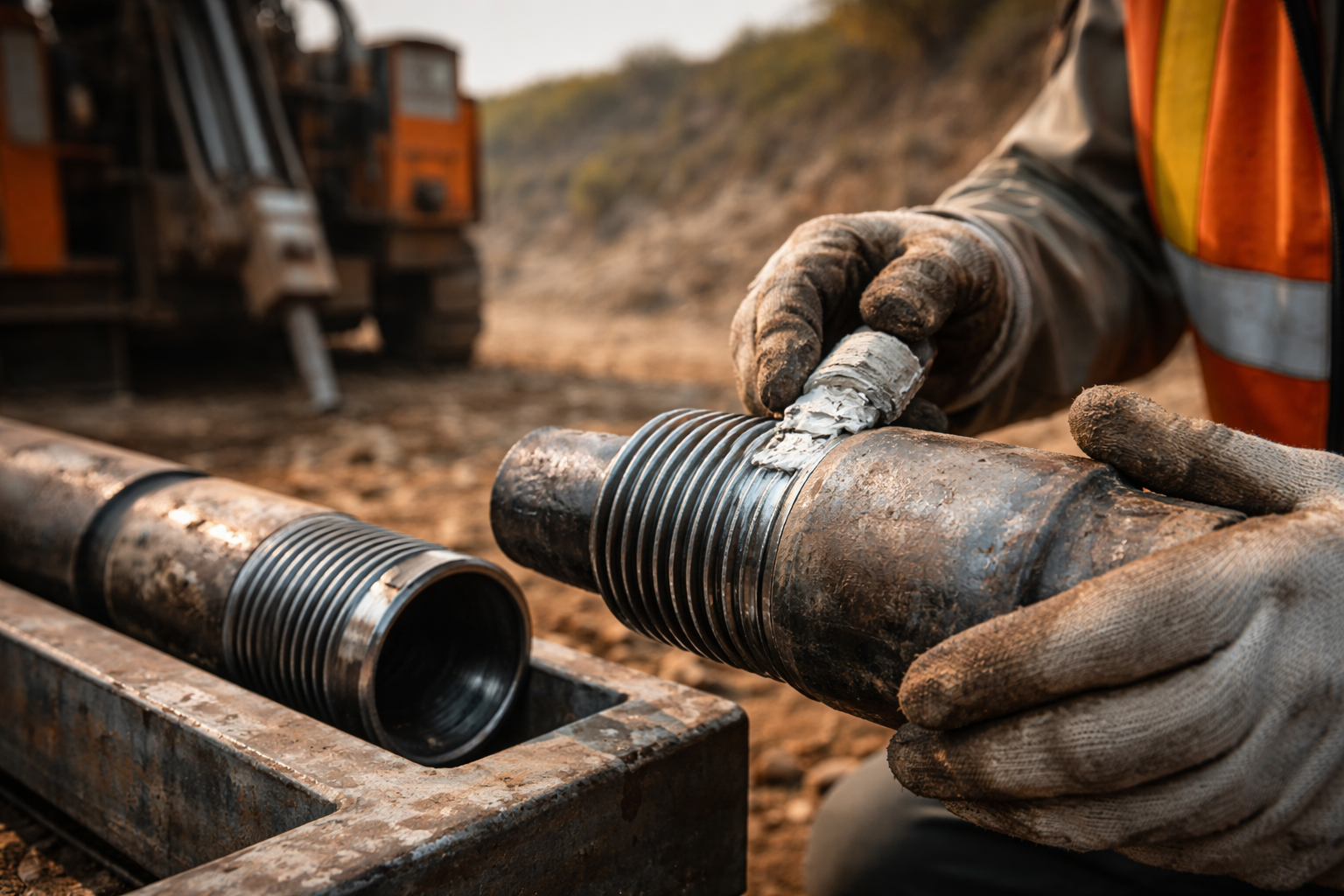
Thread compound should be applied evenly and consistently. Too little increases friction. Too much attracts contamination.
Rushed operations increase cross-threading risk. Fatigue and time pressure contribute significantly to connection damage.
Rod failure prevention is rarely about one dramatic mistake. It is about small procedural shortcuts repeated daily.
Early Warning Checklist Before It Becomes a Twist-Off
Supervisors should watch for the following indicators:
- Uneven makeup turns
- Grinding sensation during breakout
- Shiny high spots on thread faces
- Visible metal transfer
- Recurring torque spikes on similar depth intervals
- Audible chatter under load
- Increased vibration during rotation
- Thread compound burn-off
- Excessive breakout force required
- Rods are heating abnormally at connections
- Inconsistent final torque readings
- Repeated issues in the same rod position
Early intervention prevents escalation.
When these signs appear, the rod should be removed and inspected rather than forced back into service.
Practical Prevention System That Works on Remote African Sites
Remote operations require simple, repeatable systems.
Daily Routine
- Clean threads before every makeup
- Inspect visually for metal transfer or deformation
- Apply consistent thread compound
- Monitor torque readings
- Replace thread protectors immediately after breakout
Weekly Inspection Routine
- Inspect high-cycle rods in detail
- Check subs and crossover joints
- Inspect wrench jaws and torque equipment
- Remove suspect rods from active rotation
Storage and Handling SOP
- Store rods off the ground
- Use racks with drainage
- Keep threads protected at all times
- Separate damaged rods from active inventory
Minimum Spares Strategy
Remote sites should maintain:
- Spare subs
- Thread protectors
- Approved thread compound
- Basic thread gauges
- Backup torque measurement tools
Preventative maintenance drilling procedures must assign clear responsibility. One role must own inspection discipline. When responsibility is unclear, standards decline.
When to Repair Versus Replace
Not all thread wear requires immediate disposal. However, the threshold must be defined.
Repair may be possible when:
- Minor surface deformation is present
- The thread profile remains structurally intact
- No visible cracks exist
Immediate removal from service is required when:
- Threads show deep galling
- Cracks are visible near the thread roots
- Cross-threading has distorted geometry
- Makeup cannot be applied smoothly
Running a questionable rod “for one more hole” often leads to major downtime.
The cost of replacement is predictable. The cost of twist-off is not.
Where Tooling Choice Matters
Connection longevity is influenced by compatible consumables and consistent component quality.
Correctly specified consumable core drilling products reduce premature wear and promote uniform load distribution across the string.
In unstable or shallow ground conditions, vibration and misalignment can increase thread stress. Appropriately matched geotechnical drill rigs help maintain alignment and reduce abnormal loading.
In confined underground conditions, a proper setup and positioning using suitable underground drill rigs support better torque control and reduce mechanical stress on connections.
Equipment suitability supports rod failure prevention by stabilising mechanical loads.
Thread Discipline Protects Performance
Drill rod thread damage is rarely dramatic at the start.
It begins with small signals:
- Slight resistance
- Uneven torque
- Minor visible wear
When crews respond early, downtime is avoided.
When small signals are ignored, they become failures.
Thread discipline is not an administrative task. It is a cost-per-meter protection strategy.
Operations that treat connection integrity as a controlled system reduce non-productive time, extend rod life, and stabilise performance across entire drill programs.
Frequently Asked Questions
What causes thread galling in drill rods?
Thread galling occurs due to friction and metal transfer between mating surfaces, often caused by insufficient lubrication, contamination, or inconsistent torque.
How do you prevent cross-threading on the site?
Ensure proper alignment before makeup, never force a connection that does not start smoothly, clean threads thoroughly, and maintain consistent torque procedures.
What torque discipline should crews follow?
Crews should follow manufacturer specifications consistently, avoid over-tightening, and monitor torque readings for irregular patterns.
When should a rod be removed from service?
A rod should be removed when threads show deep galling, visible cracks, distorted profiles, or when smooth makeup cannot be achieved.