The True Cost of a Snap – Why Cheap Drill Pipe is a False Economy
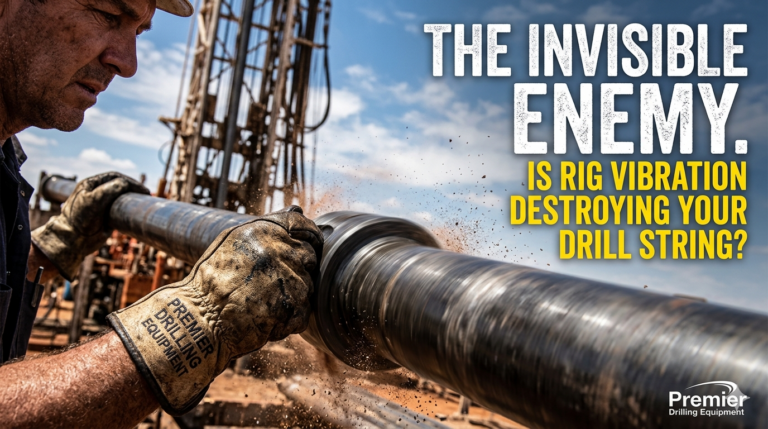
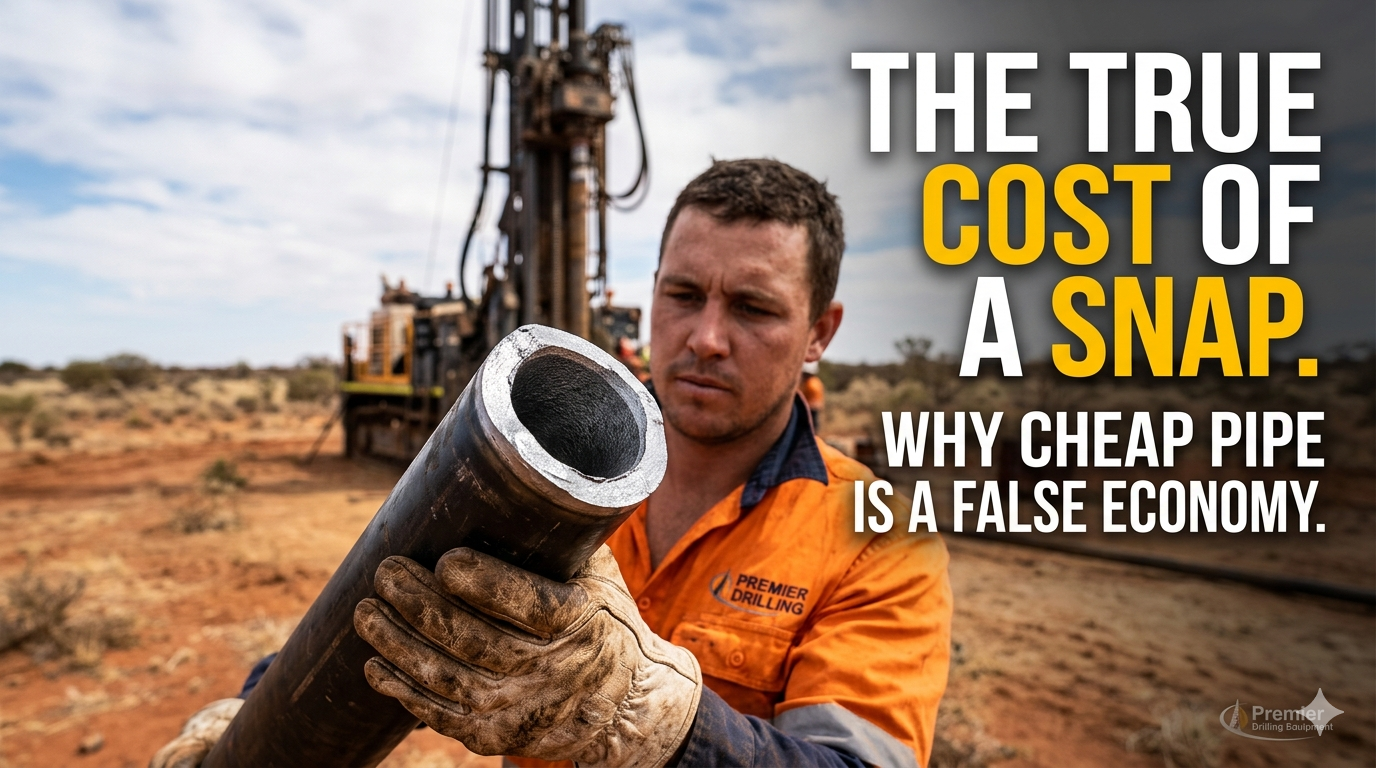
You’re 300 metres down in a remote stretch of the Northern Cape. The rig is humming, the penetration rate is steady, and then—silence. Or worse, the sudden, violent decompression of torque that every driller dreads. You pull the string, only to find a clean snap at the weld of the lead pipe.
In that moment, the R5,000 you saved by opting for a “budget” drill pipe doesn’t just vanish; it multiplies into a financial catastrophe. When a pipe fails mid-hole, you aren’t just losing a piece of steel. You are losing time, fuel, recovery tool rentals, and potentially the entire borehole.
At Premier Drilling Equipment, our “Total Drilling Cost” philosophy dictates that the most expensive pipe you can buy is the one that fails. Here is the technical reality of why cheap pipe is a false economy.
The Mechanics of the “Snap”: Inertia Welding vs. The Rest
The weld is the soul of the drill pipe. It is the point where the tool joint meets the tube, and in high-torque environments, it is the most common point of catastrophic failure.
Most budget manufacturers rely on standard friction welding or, in some cut-rate cases, basic induction welding. These processes often leave a distinct Heat Affected Zone (HAZ) that creates a brittle transition point. Under the intense lateral loads and rotational harmonics of a deep-hole mission, these brittle zones develop micro-fractures that lead to a “snap.”
We utilise Inertia Welding. Unlike standard friction welding, inertia welding uses a massive flywheel to store energy, which is discharged rapidly to create a forge-type molecular bond. This results in a full-surface weld with a remarkably small HAZ. The result? A joint that is often stronger than the tube itself.
Material Science: Why S135 Grade is Non-Negotiable
In the South African drilling landscape—where we often contend with highly abrasive formations and unpredictable shifts in ground pressure—the chemistry of the steel matters.
Cheap pipes often use “equivalent” grades that lack the consistent quenching and tempering required for S135 Grade certification. S135 isn’t just a label; it’s a promise of a specific yield strength (135,000 psi). When you are pushing the limits of your rig’s pull-back capacity to free a stuck string, that extra margin of tensile strength is the difference between a successful recovery and a permanent “fish” in the hole.
Using non-API spec steel in a high-torque environment is like using a passenger car tyre on a 30-tonne side-tipper. It might hold air while it’s parked, but it will disintegrate under load.
The Math: Purchase Price vs. Operational Risk
Let’s look at the “Total Drilling Cost” breakdown.
- The “Saving”: You buy a string of 50 pipes and save R200 per pipe. Total saving: R10,000.
- The Failure: One pipe snaps at depth.
- Rig Standing Time: 12 hours at R2,500/hr = R30,000.
- Fishing Tool Rental & Specialist: R15,000.
- Lost Consumables: (Inner tubes, bits, etc.) R8,000.
- Diesel Wasted: Re-drilling the lost metres = R5,000.
A single failure on a single pipe has now cost you R58,000. That “saving” of R10,000 has resulted in a net loss of R48,000. This doesn’t even account for the reputational damage when a client’s exploration programme falls behind schedule.
The African Context: Logistics are the Real Killer
In Europe or North America, a replacement pipe is a few hours away. In the African bush, logistics are a force multiplier for downtime. If you’re drilling in a remote corner of Botswana or the Limpopo valley, “Next Day Delivery” doesn’t exist.
Waiting for a replacement string to clear border posts or navigate gravel roads adds days—not hours—to your downtime. Reliability isn’t just a technical preference; it is a logistical necessity.
Field Note: The 5-Second Fatigue Check
Before every shift, run a rag over the first three threads of your box and pin ends. If the rag snags on “burrs” or invisible pitting, you’re seeing the first signs of galling or fatigue. Don’t risk the hole—retire the pipe immediately. A retired pipe is an expense; a snapped pipe is a disaster.
Conclusion: Ruggedised for the Long Game
Drilling is a game of margins. You can try to find those margins in the initial purchase price, or you can find them in rig uptime and hole integrity.
By investing in precision-engineered, inertia-welded S135 pipe, you are buying insurance against the “snap.” You are ensuring that your “Total Drilling Cost” stays low, your ROP stays high, and your rig stays turning.