The “Green” Metre: Reducing Fuel Consumption Through MBI Bit Efficiency
In the modern South African mining landscape, the mandate is clear: increase productivity while radically reducing environmental impact. While large-scale electrification and renewable integration dominate the headlines, operational efficiency remains the most immediate path to reducing Scope 1 emissions. In exploration and definition drilling, this efficiency is dictated by the interaction between the drill bit and the rock.
The true environmental cost of a hole is not found in the matrix metallurgy, but in the diesel consumed by the rig while making that metre. By focusing on fundamental engineering principles and matrix selection, MBI’s high-performance impregnated bits provide a direct mechanism for South African mines to meet their ESG targets through measurable fuel reduction.
Engineering the Efficient Cut: Torque vs. Consumption
The engineering relationship between a drill bit and fuel consumption is simple: a bit that is too hard for the geology will glaze. A glazed bit stops cutting, forcing the operator to increase the weight-on-bit (WOB) and apply excessive torque to achieve penetration.
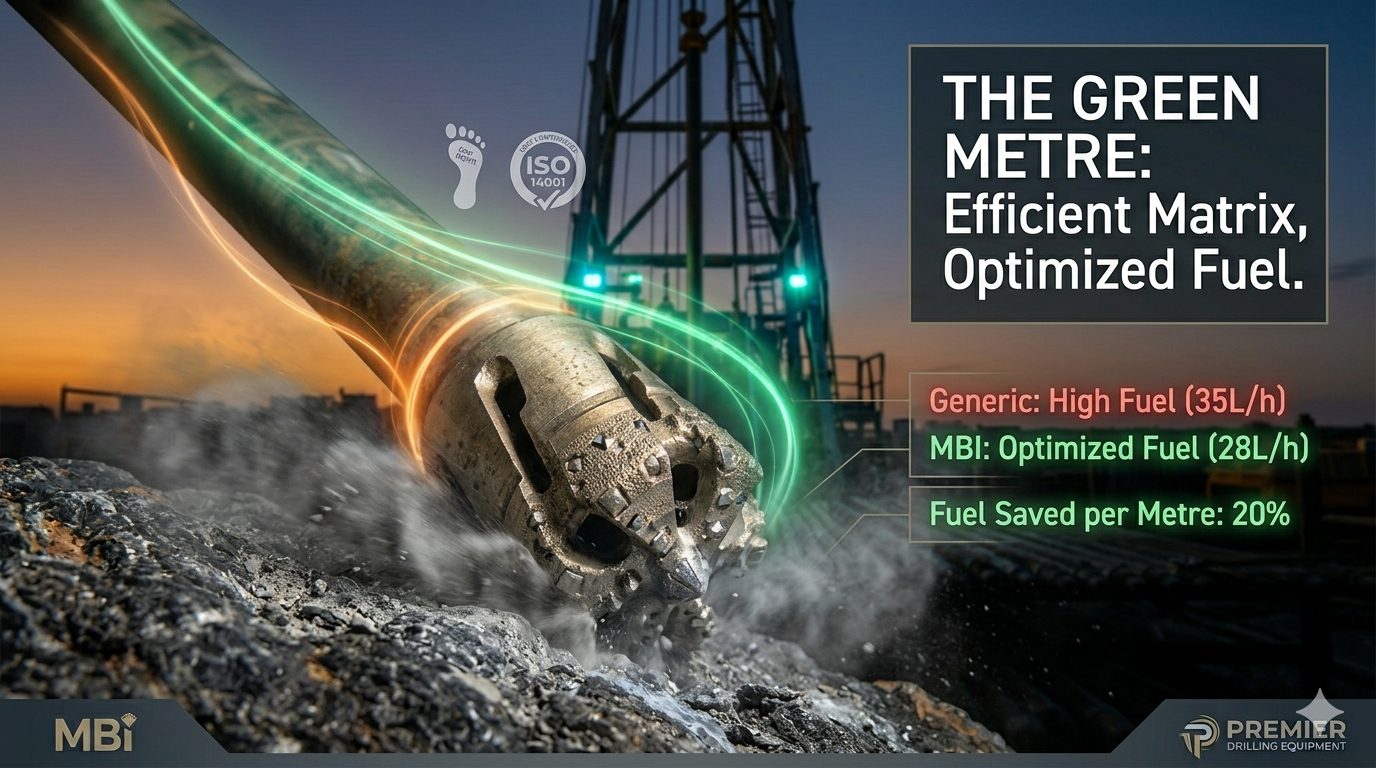
This scenario places a massive, inefficient load on the drill rig’s hydraulic pump and engine, causing diesel consumption to spike. Conversely, a sharp, free-cutting MBI bit operates at an optimized ROP (Rate of Penetration) with lower required torque. When a bit cuts efficiently, the rig consumes less energy—and less fuel—per metre drilled.
The “Self-Sharpening” Matrix as a Sustainability Tool
MBI matrices are engineered to manage self-sharpening at precise rock hardness scales. When matched correctly to the abrasive Witwatersrand quartzite or Bushveld platinum reef, an MBI matrix erodes at a controlled rate, consistently exposing sharp diamonds.
- Continuous Cutting: Because fresh diamonds are always engaged, the bit maintains a stable ROP, preventing the “glazing cycle” where productivity plummets while fuel use remains high.
- Reduced Friction: Effective matrix erosion ensures there is a clean, sharp cutting action with minimal friction. Lower friction results in less heat and lower torque, translating directly into reduced hydraulic system drag and a lower engine load.
Case Study: Tallying the Fuel Savings
The impact of matrix efficiency becomes clear when you quantify the energy required to complete a hole. Consider a standard 1,000m deep-hole definition programme in abrasive geology. A single MBI matrix formula tailored for this geology was compared to a generic “budget” bit that was marginally too hard for the formation.
Fuel and Performance Comparison: MBI tailormade Matrix vs. Generic Bit
| Metric | Generic “Budget” Bit | MBI tailormade Matrix | Impact of Efficiency |
|---|---|---|---|
| Bit Status | Frequent Glazing | Self-Sharpening/Free-Cutting | MBI maintained sharpness |
| Average ROP | 6 cm/min | 9 cm/min | +50% faster drilling |
| Est. Engine Load | High (85-90%) | Moderate (65-70%) | Lower hydraulic demand |
| Fuel Consump. (Rig) | 35 L/hr | 28 L/hr | -20% fuel use per hour |
| Time to 1,000m | 277 Drilling Hours | 185 Drilling Hours | 92 hours saved (Rig) |
| Total Diesel (Drilling) | 9,695 Litres | 5,180 Litres | 4,515 Litres Saved |
| Operational Impact | Low metres/shift, high fatigue | High metres/shift, consistent | High productivity + safety |
| By utilizing a sharper-cutting MBI bit, the mine not only increased productivity but also saved over 4,500 litres of diesel per 1,000m hole. |
Beyond the Bit: Scope 1 Emissions Reduction
Minimizing unnecessary fuel consumption is the core strategy for managing Scope 1 emissions. A single glazed bit that requires a re-sharpening run or results in a premature rod pull contributes immediately to carbon output. Efficient, predictable MBI tooling ensures that every rotation of the chuck translates into progressive metres, optimizing the entire carbon lifecycle of the drill hole.
Technical Note: Optimizing Rig Settings for Fuel Efficiency
A sharp bit is useless if the rig settings are incorrect. Ensure drillers use recommended ROP/Torque parameters for the specific MBI matrix formula. Operating outside these ranges—especially excessive RPM when the bit is beginning to wear—will waste fuel through friction and heat rather than efficient rock penetration.Engineering a Sustainable African Mining Sector
Premier Drilling Equipment is dedicated to bridging MBI’s global engineering R&D with the localized ESG and operational reality of Southern Africa. By selecting the correct MBI matrix, you aren’t just buying a bit; you are adopting a sustainable drilling model where increased ROP and reduced environmental impact are complementary engineering goals.
Is inefficient drilling wasting your fuel budget?
Contact the Premier Drilling technical team today to audit your current bit performance and let us engineer a customized matrix solution to secure your next “Green” Metre.