The Precision Mandate: Why Geotechnical Site Investigations Require MBI Core Barrels
In geotechnical site investigations (GSI), the objective diverges sharply from conventional mineral exploration. While deep-hole exploration focuses on rate of penetration (ROP) and intersection depth, GSI is defined by a singular, non-negotiable metric: Core Recovery Rate (CRR). In infrastructure projects—whether it’s a dam foundation in the DRC, a bridge abutment in the Western Cape, or an urban rail project—lost core means lost data, and lost data introduces catastrophic engineering risk.
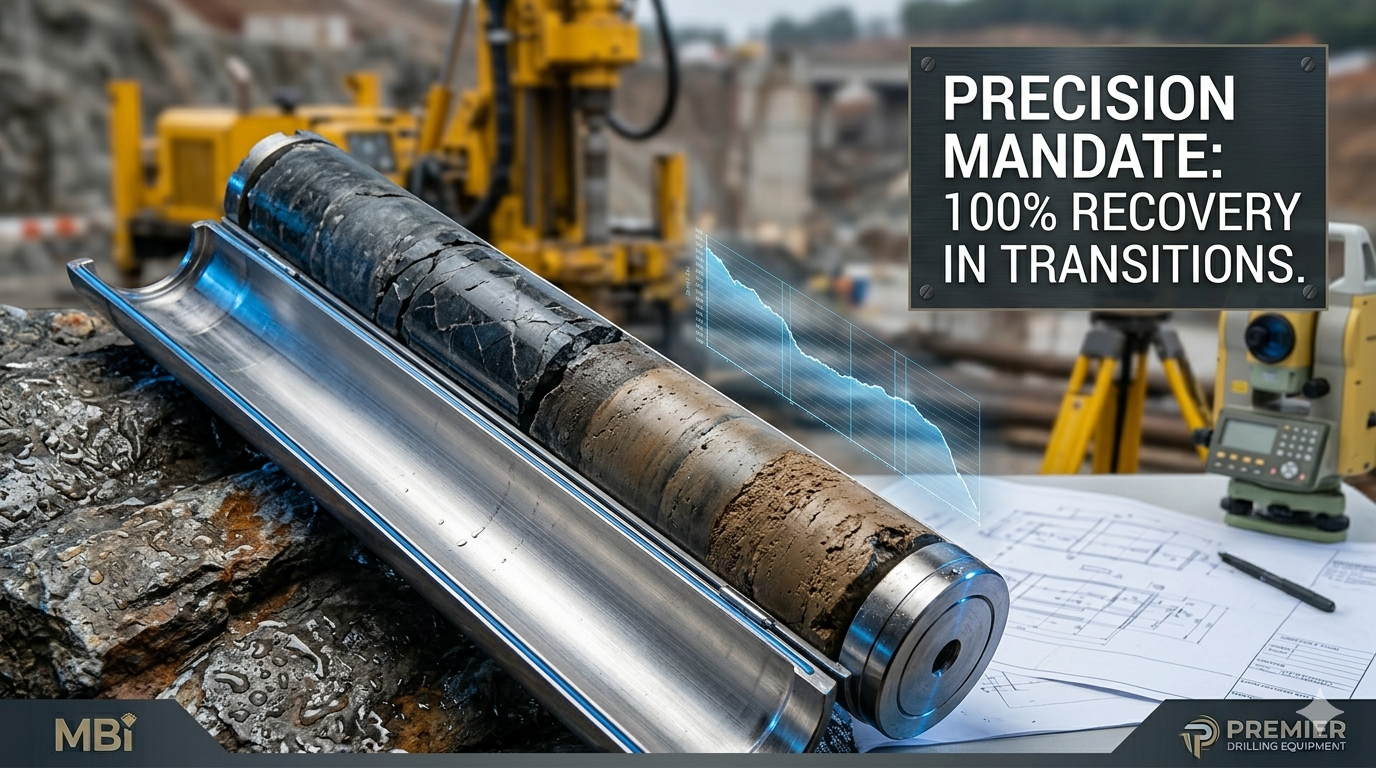
Retrieving 100% core recovery across highly variable geology, especially difficult weathered rock-to-soil transitions, demands more than just drilling skill. It requires equipment engineered specifically to protect the sample. This Field Note examines why MBI’s specialized core barrel systems are essential for data security in geotechnical operations.
The Critical Nature of Core Recovery (CRR)
A geotechnical engineer’s foundation design is only as reliable as the subsurface data they receive. In fragmented or weathered formations, standard drill strings often vibrate excessively, leading to:
- Core Spinning: The sample rotates inside the inner tube, grinding itself into unusable fines.
- Core Wash: Drilling fluid interacts directly with delicate samples, eroding them before they are recovered.
- Core Blocking: Fragmented rock jams the inner tube lifter, causing “premature block,” halting drilling, and often destroying the existing sample upon retrieval.
MBI systems mitigate these risks through precision engineering that surface-grade budget tooling cannot match.
Engineering for Transitions: The Inner Tube Advantage
The critical interface in sample protection is the inner tube. Where generic barrels use generic seamless tubing, MBI engineering applies specialized heat treatment and precise dimensional tolerances.
- Tolerance and Concentricity: MBI inner tubes maintain strict concentricity (true circularity along the length of the tube). This is crucial for keeping the sample stable and centered, preventing the eccentric rotation that causes core spinning.
- Surface Finish: The exceptionally smooth internal surface of the MBI inner tube reduces the friction resistance of the incoming core. A low-friction entry is vital for recovering undisturbed samples in friable ground or cohesive soils.
Stabilizing the Core: MBI’s Core-LOK and Data Security
Once the core is inside the tube, it must be securely retained during retrieval. Standard core lifters often fail in soft, sandy, or highly fractured geotechnical ground.
MBI’s Core-LOK technology addresses this weakness. By optimizing the geometry and hardness of the core lifter (the ‘spring’) and the mating surface of the inner tube lifter case, MBI ensures a progressive, powerful grip. Whether recovering competent granite or sensitive soil transitions, Core-LOK provides positive retention, dramatically reducing ‘dropped core’ events that require expensive re-drilling.
Geotech Note: Minimizing Core Spinning in Fractured Foundations
To reduce core spinning when entering highly fractured ground or existing concrete foundations, ensure your MBI core barrel is operating with minimal vibration. Check stabilizing rings and internal tolerances, as excessive lateral movement will transfer directly to the delicate sample.The Financial Case for Premium Data
The purchase price of an MBI geotechnical core barrel is marginally higher than generic alternatives. However, when viewed through a Total Cost of Ownership (TCO) model, the math is clear.
In a GSI programme, the cost of re-drilling a single failed 15m geotechnical borehole can exceed R100,000 in rig time, mobilization, and labor. If accurate data is missing, the cost escalates dramatically through over-engineered foundations (unnecessary cost) or under-engineered foundations (catastrophic failure risk).
An MBI core barrel is not just tooling; it is an investment in Data Sovereignty—ensuring the geotechnical engineer owns the precise subsurface data required for safe, economical design.Engineering Predictability in Infrastructure
At Premier Drilling Equipment, we understand that geotechnical precision directly impacts the viability of major infrastructure. By aligning with MBI’s precision engineering, we ensure that our Southern African partners are equipped to meet the ‘Precision Mandate’ of high-stakes investigations.
Is your geotechnical data at risk due to poor core recovery?
Contact the Premier Drilling technical team today for an Inner Tube Stabilization Audit and ensure your infrastructure samples are built on secure data.