How to Select the Right Drill Rig for African Mining Conditions: Surface, Underground, Mobile and Geotechnical Applications
A drilling program begins with confidence. Budget approved. Depth targets defined. Timeline locked.
Then terrain shifts. Access roads wash out. Ground conditions vary unexpectedly. Ventilation constraints appear underground. Mobilization takes longer than planned. Consumable burn rate exceeds projections.
The problem is rarely only geology.
In African mining environments, drill rig selection is not just a technical decision. It is a strategic capital and operational decision that directly affects cost per meter, safety exposure, logistics complexity and program certainty.
This guide provides a structured framework for selecting the right rig type for real-world African operating conditions.
The Core Variables That Should Drive Rig Selection
Before comparing rig categories, decision-makers should evaluate the variables that consistently impact drilling performance across African sites.
Terrain Accessibility
Is the site:
• Open pit with road access
• Remote with limited infrastructure
• Mountainous or soft ground
• Underground with constrained tunnel geometry
Access dictates mobilization complexity and rig footprint requirements.
Depth Requirements
Maximum planned depth affects:
• Mast configuration
• Rod handling system
• Power capacity
• Core barrel compatibility
Under-specifying depth capability leads to lost productivity or premature upgrades.
Ground Stability
Highly fractured ground or unstable formations may require:
• Specialized feed control
• Enhanced rod handling discipline
• Stable mast configuration
• Rig stability systems
Geotechnical uncertainty should influence equipment robustness.
Infrastructure Availability
Evaluate:
• Power supply
• Water access
• Maintenance facilities
• Fuel storage
Remote programs must account for infrastructure limitations.
Mobilization Constraints
African projects often face:
• Border delays
• Limited heavy transport availability
• Seasonal road access restrictions
• Long supply chains
Modularity and transportability can determine program viability.
Climate Conditions
Dust, heat, and seasonal rainfall cycles impact:
• Hydraulic systems
• Cooling performance
• Electrical systems
• Corrosion exposure
Rig durability under harsh climates should be evaluated.
Crew Size and Skill Level
Availability of experienced operators affects:
• Automation requirements
• Rig complexity
• Training demands
• Maintenance capability
Equipment must align with crew competence.
With these variables defined, we can evaluate rig categories more precisely.
Surface Drill Rigs
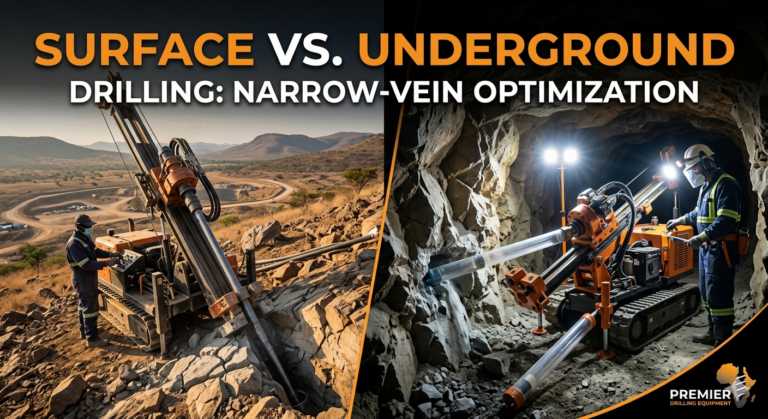
For open-pit exploration and greenfield programs with reasonable access, surface drill rigs are often the primary choice.
Surface drill rigs offer:
• High productivity
• Greater depth capability
• Robust mast and feed systems
• Suitable performance for major rock drilling challenges
They are ideal when:
• Road access is established
• Large drilling programs are planned
• Depth requirements are significant
• Productivity per shift is critical
Limitations include:
• Larger transport requirements
• Reduced suitability in highly restricted terrain
• Greater mobilization planning
In stable access environments, surface drill rigs maximize production efficiency and cost per meter performance.
Underground Drill Rigs
When drilling within established workings or development tunnels, underground drill rigs become essential.
Underground environments impose constraints such as:
• Limited headroom
• Ventilation requirements
• Restricted maneuverability
• Safety compliance complexity
Underground drill rigs are designed for:
• Confined spaces
• Tunnel stability considerations
• Controlled feed systems
• Reduced footprint
They are optimal when:
• Drilling occurs within existing mine development
• Exploration targets are beneath active workings
• Access is only available via shafts or declines
The trade-off often involves:
• Lower maximum depth relative to large surface rigs
• Higher emphasis on maneuverability
• Ventilation and power management considerations
Proper rig sizing underground reduces safety risk and improves operational efficiency.
Mobile Drill Rigs
For remote exploration campaigns and contractor flexibility, mobile drill rigs provide critical advantages.
Mobile drill rigs are ideal for:
• Rapid deployment
• Early-stage exploration
• Programs requiring frequent relocation
• Limited site infrastructure
They offer:
• Reduced mobilization time
• Easier transport
• Lower initial infrastructure demands
• Greater operational agility
Mobile rigs are particularly valuable in African contexts where:
• Seasonal access roads deteriorate
• Transport windows are narrow
• Border crossings create uncertainty
• Smaller crews operate in isolated camps
However, decision-makers must evaluate:
• Depth limitations
• Consumable compatibility
• Stability on soft or uneven ground
When mobility drives productivity, these rigs provide strategic flexibility.
Geotechnical Drill Rigs
Mining infrastructure projects require a different rig profile.
For investigations involving:
• Tailings facilities
• Plant pads
• Haul roads
• Foundations
• CPT testing
geotechnical drill rigs are the correct solution.
These rigs prioritize:
• Precision
• Controlled sampling
• Integration with CPT systems
• Data-driven infrastructure planning
They are critical when:
• Risk reduction precedes construction
• Soil characterization is required
• Tailings stability is under review
• Infrastructure expansion is planned
Geotechnical drill rigs do not focus solely on depth or speed. They focus on data integrity and risk mitigation.
Consumables Compatibility and Lifecycle Cost
Rig selection must also consider long-term consumable compatibility.
Drill rods, casing, bits and reaming shells directly influence:
• Cost per meter
• Downtime
• Maintenance cycles
• Thread integrity
• Core recovery
High-quality consumable core drilling products ensure that the selected rig operates at optimal efficiency.
Incompatible consumables increase:
• Thread damage
• Tool wear
• Stuck rod incidents
• Lost production time
Lifecycle cost often exceeds initial capital cost. Rig selection must align with consumable performance expectations.
Field Log Example: When the Wrong Rig Increased Cost per Meter
Initial Assumption
A remote exploration campaign selected a high-capacity surface rig based on projected depth requirements.
Operational Constraint
Access roads deteriorated during seasonal rainfall. Transport vehicles could not reliably reposition the rig between drill pads.
Performance Impact
• Delayed relocation
• Increased idle time
• Higher fuel consumption
• Escalating cost per meter
Corrective Decision
Transitioned to a more modular mobile drill rig better suited to terrain constraints.
Outcome
• Reduced relocation time
• Improved site flexibility
• Stabilized cost per meter
• Shortened program timeline
Rig choice directly influenced financial performance.
Rig Selection Decision Matrix
Rig Type | Ideal Terrain | Depth Range | Mobilization Complexity | Crew Requirements | Best Use Case
Surface Drill Rigs | Open pit, road access | Medium to deep | Moderate to high | Skilled crew | Large exploration programs
Underground Drill Rigs | Tunnels, confined spaces | Shallow to medium | Moderate | Specialized underground crew | In-mine exploration
Mobile Drill Rigs | Remote, variable access | Shallow to medium | Low to moderate | Small agile crew | Early-stage or remote exploration
Geotechnical Drill Rigs | Infrastructure sites | Shallow to medium | Moderate | Data-focused team | Soil and tailings investigations
This matrix simplifies initial evaluation but must be contextualized to project-specific conditions.
Procurement Considerations
Procurement teams should evaluate:
• Capital purchase vs contract drilling model
• Spare parts availability in-country
• Technician support availability
• Training programs
• Warranty structure
• Long-term maintenance support
Supplier stability and technical support capability reduce risk exposure.
Cost evaluation must include:
• Consumables burn rate
• Downtime risk
• Maintenance intervals
• Crew training needs
• Mobilization frequency
Rig selection influences total project economics.
Conclusion
Selecting the correct drill rig in African mining environments requires more than matching depth capacity.
It requires evaluating:
• Terrain
• Access
• Climate
• Crew capability
• Consumable integration
• Infrastructure constraints
The wrong rig increases cost per meter, delays schedules and amplifies operational risk.
The right rig aligns capability with environment and long-term performance goals.
Rig selection is not simply technical. It is strategic.
Premier Drilling Equipment supports structured rig evaluation across surface, underground, mobile and geotechnical applications to ensure drilling programs remain productive, predictable and cost-efficient across Africa.
Frequently Asked Questions
What is the most important factor in drill rig selection?
Terrain accessibility and project objectives are often the primary drivers, followed closely by depth requirements and mobilization constraints.
Are mobile drill rigs suitable for deep exploration programs?
Mobile drill rigs are ideal for flexibility and remote deployment but may have depth limitations compared to larger surface rigs.
How does rig selection affect cost per meter?
Incorrect rig selection can increase downtime, relocation time, consumable wear and maintenance costs, all of which raise cost per meter.
When should geotechnical drill rigs be used instead of surface rigs?
Geotechnical drill rigs should be used when infrastructure risk assessment, soil characterization or tailings investigation is the primary objective.
Do consumables influence rig performance significantly?
Yes. Consumable compatibility directly affects thread integrity, bit life, downtime frequency and overall drilling efficiency.