Cost-Per-Meter Reality: Where Most African Drill Programs Quietly Lose Money
Drilling budgets do not usually fail because of one catastrophic mistake. They fail quietly.
A program begins on schedule. Tooling arrives. Crews mobilize. Early penetration rates look acceptable. Then productivity begins to fluctuate. Core recovery drops slightly. A few threads are damaged. A pump fails. A spare is delayed. A hole requires confirmation drilling.
Individually, none of these issues appear critical.
Collectively, they redefine drilling cost per meter Africa operations depend on to remain profitable.
In African drilling environments, where logistics are extended, water is constrained, and response times are rarely immediate, cost-per-meter is driven far more by operational discipline than by consumable unit price.
This Field Note breaks down where programs quietly lose money and how experienced operators control it.
What Cost-Per-Meter Actually Represents
Cost-per-meter is often simplified as total drilling cost divided by total meters drilled. Operationally, that number is shaped by multiple interacting variables.
Consumables
Bits, reaming shells, rods, casings, core barrels, and additives are visible costs. They are budgeted, ordered, and tracked.
However, tooling quality and suitability directly influence penetration rate, recovery, and failure frequency. Properly specified <a href=”https://premierdrillingequipment.co.za/consumable-core-drilling-products/”>consumable core drilling products</a> do not simply reduce replacement frequency. They influence mechanical stability and productivity per hour.
Consumables are not just an expense category. They are a performance variable.
Labour
Labour cost remains constant regardless of output. When penetration drops from 3 meters per hour to 2.2 meters per hour, labour cost per meter increases immediately.
Reduced productivity inflates cost-per-meter without changing payroll.
Non-Productive Time (NPT)
Non productive time drilling is one of the largest and least disciplined contributors to cost escalation.
NPT includes mechanical failures, stuck rods, thread damage, pump issues, power interruptions, waiting on spares, and hole instability.
Every hour not drilling increases effective cost-per-meter.
Re-Drilling and Core Loss
Poor recovery or deviation results in additional holes. Geological uncertainty forces confirmation drilling. These meters are rarely reflected transparently in initial cost models.
Each re-drilled meter inflates the true cost of the original program.
Logistics
In African conditions, logistics amplify small failures. Remote access, border delays, freight congestion, and seasonal road conditions extend downtime exposure far beyond what many budgets anticipate.
The Hidden African Multipliers
Drilling cost per meter Africa projects encounter is shaped by environmental and structural realities.
Remote Site Exposure
When a project is hundreds of kilometres from a supply hub, a failed component is not a minor inconvenience. It can immobilize a rig for days.
Idle crews remain on payroll. Support vehicles continue operating. Camp infrastructure continues consuming fuel and supplies.
The meter count does not increase, but cost-per-meter does.
Energy Instability
Stop-start drilling caused by unstable power supply increases mechanical stress. It reduces penetration consistency and accelerates component fatigue.
Over time, this increases downtime frequency and repair cycles.
Water Constraints
Limited water supply requires disciplined fluid management. Poor fluid control increases hole collapse risk, stuck tooling, and deviation.
Water scarcity is not just an environmental variable. It is a productivity variable.
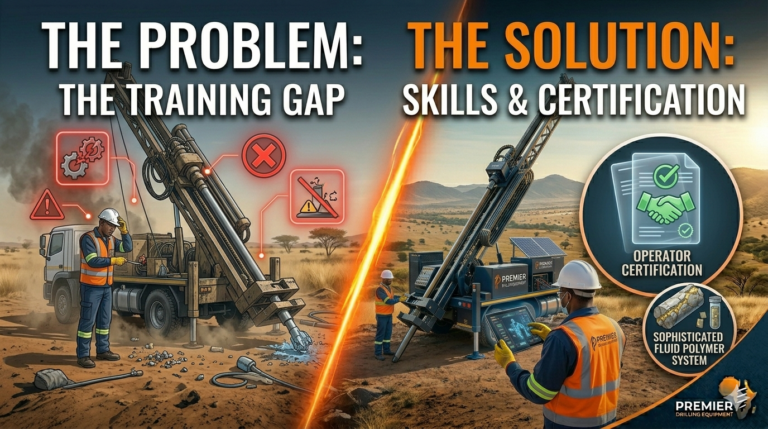
Skills Gaps and Crew Turnover
High turnover reduces torque discipline, thread care, and early fault detection. Small mechanical issues that could be corrected quickly become larger failures.
Cost-per-meter increases through preventable escalation.
Downtime: The Silent Budget Killer
Consider a realistic scenario.
A rig operating cost, including labour, fuel, and overhead, totals R18,000 per hour. Target penetration is 3 meters per hour. Planned daily output is 24 meters.
If 4 hours are lost due to preventable thread damage, the cost impact is immediate.
Four hours at R18,000 equals R72,000.
Lost production equals 12 meters.
That loss increases cost-per-meter across the entire program. When repeated across multiple holes, the compounded effect becomes substantial.
Downtime rarely announces itself dramatically. It accumulates quietly.
Tool Selection Versus Tool Price
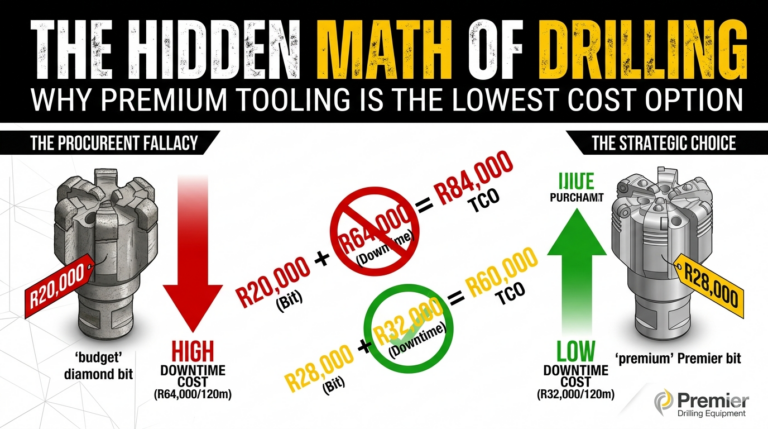
Procurement decisions often prioritize unit cost over performance impact.
Drill Bit Selection
A lower-cost bit may wear faster in abrasive ground. Penetration slows. Torque increases. Deviation risk rises.
If penetration drops by 25 percent, labour cost per meter rises proportionally.
The cheaper bit increases overall cost-per-meter.
Rod Integrity and Thread Discipline
Incorrect rod grade selection or poor thread maintenance results in galling, cross-threading, micro-cracks, and fatigue failure.
High-quality consumables reduce unplanned failure frequency. When rods are matched correctly to formation and load conditions, downtime frequency declines measurably.
Rig Configuration
Rig selection also directly affects cost-per-meter.
Surface exploration campaigns benefit from properly specified geotechnical drill rigs when soil and shallow investigation conditions demand precision and adaptability.
Underground campaigns require correctly matched underground drill rigs to optimize access, safety, and setup efficiency.
Rig mismatch increases setup time, reduces maneuverability, and inflates downtime.
Core Recovery and Geological Confidence
Core recovery affects more than drilling performance. It influences geological decision speed and exploration confidence.
Reduced recovery leads to confirmation holes. Confirmation holes increase program duration. Extended duration increases overhead and labour exposure.
Recovery discipline protects both drilling efficiency and geological integrity.
Logistics and Spare Planning
Emergency freight in remote regions is expensive and unpredictable. Critical component identification is essential.
Not all spares require equal priority.
Operators who differentiate between high-frequency failures and high-impact failures reduce exposure significantly.
Inventory discipline is not about stockpiling. It is about understanding operational vulnerability.
How to Reduce Drilling Cost Per Meter in African Conditions
Cost reduction does not begin with price negotiation. It begins with operational alignment.
Match Tooling to Formation
Standardization across variable geology increases risk. Tool selection must respond to lithology and depth targets.
Log Non-Productive Time Daily
Categorize downtime causes clearly. Patterns emerge quickly when documented consistently.
Protect Threads and Connections
Implement torque discipline, storage controls, and scheduled inspections. Thread damage is predictable and preventable.
Plan Critical Spares Strategically
Identify components that stop the entire operation when unavailable. Protect against those failures first.
Document Every Hole
Track penetration rate, recovery percentage, deviation, NPT, fluid adjustments, and mechanical incidents.
Data transforms performance from reactive to proactive.
Commercial Alignment Determines Profitability
Drilling cost per meter Africa operators face is rarely driven by one catastrophic event.
It is shaped by repeated small decisions involving tooling, maintenance discipline, logistics planning, and documentation rigor.
When mechanical choices align with commercial awareness, performance improves measurably.
Drilling efficiency is not accidental. It is structured.
Programs that treat cost-per-meter as a dynamic operational metric rather than a static accounting number gain measurable advantage.
Frequently Asked Questions
What drives drilling cost per meter Africa projects encounter most often?
Downtime, logistics delays, recovery loss, and improper tooling selection typically influence cost-per-meter more than consumable unit price alone.
How does non productive time drilling affect profitability?
Each hour of NPT increases effective cost-per-meter because labour and overhead continue while production stops.
Does cheaper tooling reduce drilling cost?
Not necessarily. Reduced penetration rate and increased failure frequency often increase overall program cost.
Why does rig selection matter?
Correctly specified geotechnical or underground rigs reduce setup inefficiencies, improve safety, and stabilize penetration performance.