The Hidden Math of Drilling – Why Premium Tooling is the Lowest Cost Option
In the high-pressure world of mineral exploration and mining, the procurement process is often governed by a single, seductive metric: the initial purchase price. For the Procurement Manager tasked with hitting a budget, choosing the R20,000 diamond bit over the R28,000 premium alternative seems like an obvious win.
However, at 400 metres depth, where rock hardness meets torque, that “saving” transforms into a cascading operational liability. The true cost of a drilling consumable is not what you pay the vendor; it is the Total Cost of Ownership (TCO), factoring in performance, downtime, and asset risk.
At Premier Drilling Equipment, we don’t just sell tools; we engineered them to survive the “Hidden Math” of your balance sheet. This isn’t marketing; it is mechanical reality.
The Procurement Fallacy: The Seduction of ‘Cheap’ Consumables
The logic of lowest-bid procurement falls apart on the rig floor. Why? Because drilling equipment is not a static asset; it is a critical variable in a high-cost environment.
[Image conceptualising “The Drilling Iceberg” – Purchase Price above water, massive Operational Risks below]
Consider the simple math:
- Option A: A “budget” bit costs R20,000 and averages 30 metres before failure or polishing in a hard formation.
- Option B: A premium Premier bit costs R28,000 but, due to matrix optimisation, lasts 60 metres.
At first glance, Option B costs 40% more. But on a 120-metre hole, you need four budget bits (R80,000) versus two premium bits (R56,000). You’ve already saved R24,000 in consumables alone.
Quantifying Downtime: The Burn Rate of a Static Rig
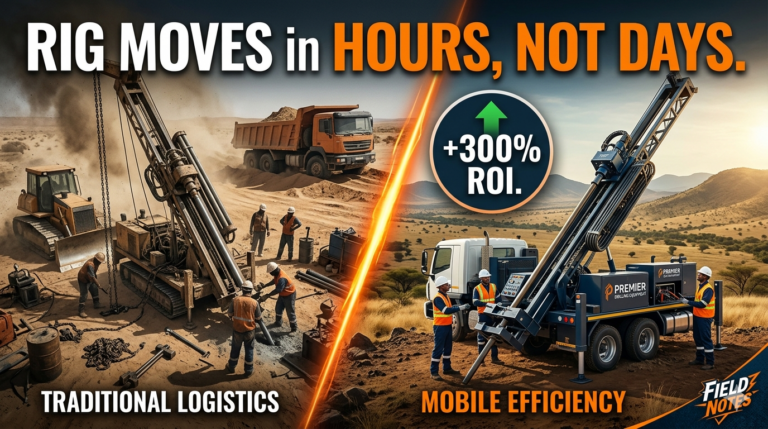
The consumables savings are minor compared to the cost of the time lost changing the bits. Every time a bit must be tripped (pulled from the hole), the drilling stops.
Imagine the operational cost of a modern diamond coring rig, including crew, fuel, and compliance overhead, is R4,000 per hour.
- Option A (Budget): Requires four trips. Total tripping time: ~16 hours. Downtime Cost: R64,000.
- Option B (Premium): Requires two trips. Total tripping time: ~8 hours. Downtime Cost: R32,000.
By choosing the R8,000 cheaper bit, you just spent R32,000 in extra rig time. The “cheap” bit is, mathematically, the most expensive bit you can put in the hole.
Risk Mitigation: Buffer Against the Invisible
Downtime is a known cost. But the most dangerous hidden costs are unexpected failures. A budget bit doesn’t just “wear out”; it can shed matrix material or drop diamonds, contaminating the hole and turning a standard retrieval into a high-risk fishing operation.
[Image showing a close-up of a damaged budget bit versus a pristine Premier bit after equivalent use]
This is where Premier’s technical innovations offer the greatest return on investment:
- Harmonic Balance: Our precision-machined subs and stabilizers (discussed in previous Field Notes) don’t just reduce vibration; they protect your rotary head from a R250,000 rebuild.
- Weld-Free Safety: Our V-LOK™ casing connection system (discussed in previous Field Notes) doesn’t just save time; it eliminates the administrative and operational cost of waiting for Hot Work permits, allowing your crew to focus on making hole.
- Thread Precision: Our precision-cut API threads, backed by the correct copper-based grease (discussed in previous Field Notes), prevent galling and “cold welding,” saving a R50,000 drill pipe from being retired prematurely.
Conclusion: Tooling is a Strategic Investment, Not an Expense
In the final analysis, the function of premium drilling equipment isn’t just to cut rock. Its function is to maximise your rig’s uptime, protect your primary assets (the rig itself and your geophysical data), and provide predictable, consistent results.
When you purchase from Premier Drilling Equipment, you aren’t spending money on a consumable; you are investing in operational certainty. You are choosing a partner that has mastered the “Hidden Math” of the Bushveld and the Northern Cape, ensuring that your low purchase price is just the beginning of a low-cost, high-profit project.
Field Note: The TCO Calculator
Before switching suppliers to save 10% on your bit or rod budget, ask these 5 questions:
- Meters-per-Hour: What is the actual penetration rate comparison, not just the bit life?
- Hourly Rig Burn: What is the all-in cost of my rig sitting static for one hour?
- Fishing Risk: Has this supplier’s tool ever failed, causing a catastrophic fishing operation?
- Compatibility: Does this “budget” tool match the strict dimensional tolerances required by my specific rig? (e.g., will it fit the breakout table?)
- Technical Support: Will a real specialist (not a salesman) be on-site within 24 hours if something goes wrong?