Extending the Lifespan of Diamond Bits in Abrasive Granite
Introduction: The Cost of Premature Bit Failure in Hard Rock
Every premature bit pull in hard rock drilling carries a measurable cost.
Rod tripping consumes productive time. Core recovery slows. Shift efficiency deteriorates. Consumable costs increase while cost per meter drilled rises. In deep exploration or geotechnical programs, a diamond bit that fails early rarely represents an isolated consumable problem—it reflects a broader interaction between geology, drilling mechanics, and parameter control.
Few formations expose this reality more aggressively than Abrasive Granite.
Granite formations with elevated quartz and feldspar content generate severe tribological stress at the bit-rock interface. Quartz, in particular, behaves as an aggressive abrasive medium. Rather than fracturing uniformly, quartz-rich cuttings continuously scour the matrix, accelerate wear, and increase frictional instability.
The result is a difficult balancing act.
A bit must remain sufficiently sacrificial to expose fresh diamonds while resisting excessive erosion. At the same time, it must withstand the destructive effects of Drilling Vibrations, which amplify fatigue, accelerate Matrix Wear, and destabilize cutting efficiency.
Understanding this interaction is fundamental to extending bit life.
The Mechanics of Matrix Wear
Why Controlled Matrix Wear Matters
The cutting efficiency of a diamond bit depends on a controlled wear process.
The matrix acts as a metallic support system that retains synthetic diamonds while gradually wearing away to expose fresh cutting surfaces. In abrasive ground, this process becomes increasingly difficult to regulate because quartz particles aggressively scour the crown during drilling.
A functional matrix must achieve two competing objectives:
- Resist excessive erosion from abrasive cuttings.
- Wear predictably enough to continuously expose fresh diamonds.
This balance defines drilling performance.
When Matrix Wear becomes unstable, penetration rates decline and premature failures emerge.
When the Matrix Is Too Soft
An overly soft matrix sacrifices itself too quickly.
In abrasive granite, high quartz concentrations rapidly strip material from the crown. Diamonds lose structural support and are dislodged before completing their intended cutting cycle.
Common consequences include:
- Premature diamond stripping
- Accelerated crown erosion
- Reduced bit gauge integrity
- Short drilling runs
- Increased traked wear along waterways
Gauge loss becomes especially problematic. As the outside diameter deteriorates, borehole stability suffers and deviation risks increase.
From a cost-per-meter perspective, soft matrices often appear productive initially because penetration may seem aggressive. However, rapid degradation results in frequent rod pulls and elevated consumable consumption.
When the Matrix Is Too Hard
Excessively hard matrices fail differently.
Instead of exposing fresh diamonds, the matrix retains worn cutting elements for too long. Diamonds polish or fracture microscopically, creating a condition commonly described as glazing.
In glazed bits:
- Diamonds lose cutting aggressiveness.
- Surface polishing reduces rock-breaking efficiency.
- Heat generation increases.
- Penetration rates decline.
This creates higher friction at the bit face and contributes directly to vibration instability.
Operators may attempt to compensate through additional Weight on Bit (WOB) or higher RPM, but doing so often worsens impact loading and fatigue.
A hard matrix that stops refreshing its cutting structure effectively becomes a polished friction surface.
The tribological objective is therefore not maximum hardness.
It is controlled sacrificial wear.
The Destructive Force of Drilling Vibrations
Why Vibrations Destroy Diamond Bits
In granite drilling, bit life is often governed less by compressive strength and more by instability.
Drilling Vibrations introduce dynamic loads that dramatically accelerate fatigue at the bit face. These loads rarely occur in a single direction.
Instead, they develop simultaneously through axial, torsional, and lateral motion.
Each mechanism damages the bit differently.
Axial Vibrations: Impact Fatigue
Axial vibration produces repetitive up-and-down loading.
The bit repeatedly lifts and slams against the formation, creating cyclic impact stresses at the diamond interface.
Consequences include:
- Diamond microfracturing
- Crown fatigue
- Matrix cracking
- Reduced cutting consistency
In severe conditions, impact fatigue produces intermittent cutting behaviour where the bit alternates between efficient penetration and violent instability.
This destabilizes drilling parameters and shortens run length.
Torsional Vibrations: Slip-Stick Behaviour
Torsional instability appears through slip-stick.
During slip-stick events, rotational energy accumulates before sudden release. The bit temporarily sticks against the formation and then rapidly accelerates.
The consequences are mechanically severe:
- Diamond edge chipping
- Localized overheating
- Uneven matrix wear
- Torque spikes
- Premature fatigue failure
Slip-stick commonly worsens when operators combine excessive WOB with insufficient RPM stabilization.
The outcome is inconsistent cutting and unpredictable wear patterns.
Lateral Vibrations: The Hidden Cause of Gauge Loss
Lateral motion is especially destructive in abrasive granite.
Poor balance or rotational instability causes the bit to orbit microscopically within the hole rather than rotating concentrically.
Instead of uniform cutting, the crown repeatedly impacts the borehole wall.
This produces anomalous wear patterns such as:
- Inside gauge loss
- Outside gauge loss
- Uneven shoulder wear
- Crown asymmetry
In practice, lateral vibration often explains why two apparently identical drilling runs deliver dramatically different bit life.
Minor imbalance quickly compounds under high RPM.
Concentricity becomes critical.
The Neolithik™ Advantage: Engineering Against Wear and Vibration
Concentricity and Balance
The operational lifespan of a diamond bit depends heavily on manufacturing precision.
The Neolithik™ Diamond Tools range is engineered with strict concentricity tolerances to reduce rotational imbalance at the cutting face.
A concentric bit distributes contact forces uniformly around the crown.
This matters because lateral vibration typically begins when rotational mass distribution becomes uneven.
Improved concentricity helps:
- Reduce lateral oscillation
- Minimize eccentric loading
- Lower gauge degradation
- Maintain cutting stability at elevated RPM
Reduced imbalance also lowers cumulative fatigue imposed on diamonds and matrix material during extended drilling runs.
The mechanical outcome is more stable wear.
Optimized Metallurgy for Abrasive Granite
In quartz-rich environments, matrix metallurgy determines survivability.
Neolithik™ Diamond Tools are engineered with matrix alloys designed to resist deep scouring caused by abrasive quartz cuttings while remaining intentionally sacrificial.
This distinction matters.
An effective matrix should not resist wear completely.
Instead, it should wear predictably.
The optimized metallurgy supports:
- Controlled diamond exposure
- Resistance to aggressive scouring
- Reduced glazing risk
- Improved sharpness retention
- Extended run consistency
Rather than stripping prematurely or polishing excessively, the matrix sustains a controlled refresh cycle that supports consistent cutting behaviour.
This directly reduces the likelihood of unstable wear progression.
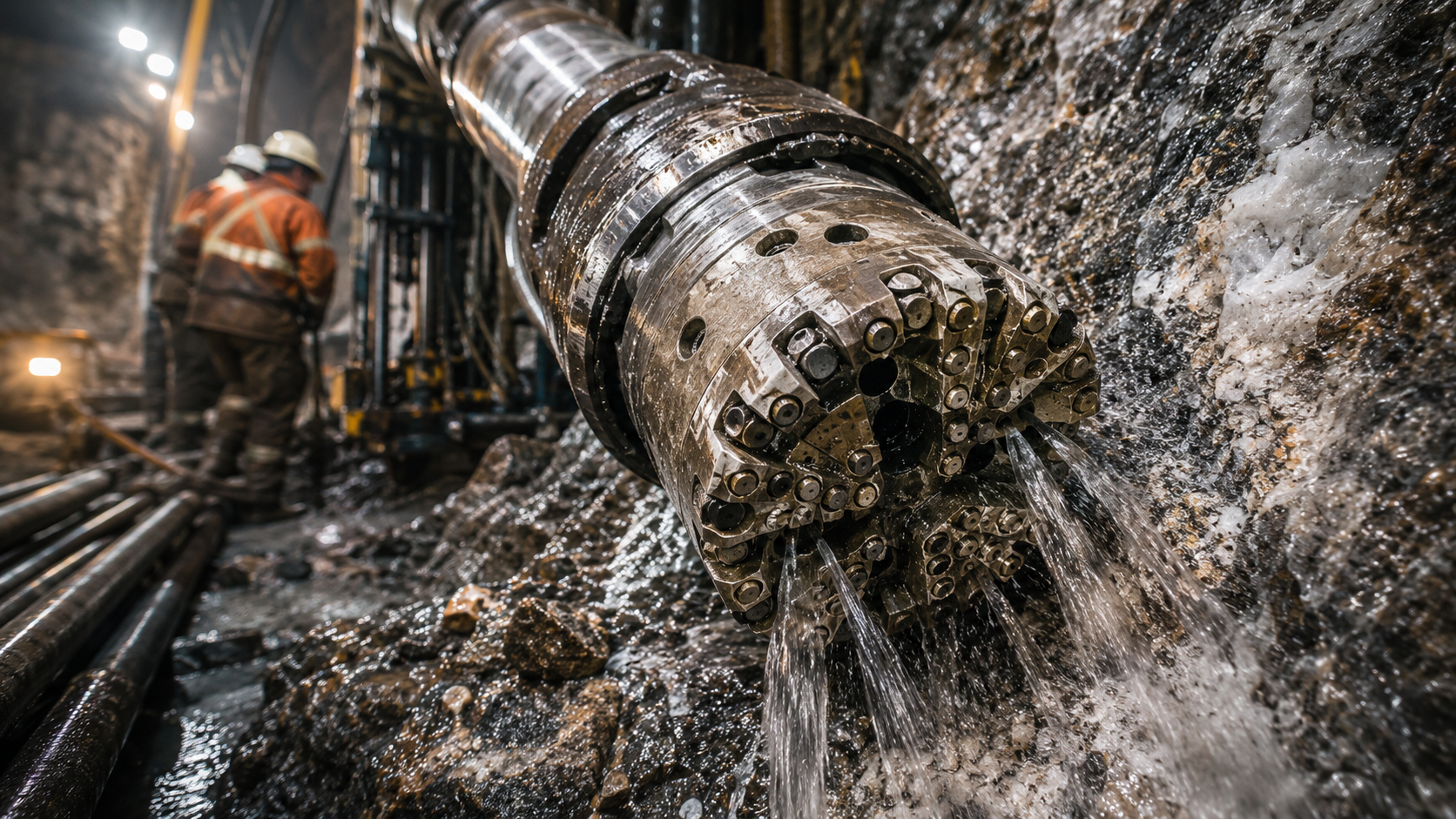
Fluid Hydraulics and Cuttings Evacuation
Bit cooling and cuttings evacuation are frequently underestimated in granite drilling.
Poor flushing increases recirculation of abrasive particles, effectively allowing quartz cuttings to scour the crown repeatedly.
Waterway design becomes critical.
The Neolithik™ Diamond Tools range incorporates fluid pathways engineered to sustain high-velocity flushing across the bit face.
Proper hydraulics provide three key benefits:
- Cooling of the crown to reduce thermal degradation
- Efficient evacuation of abrasive granite cuttings
- Reduction in recirculating wear particles
Maintaining a clean cutting interface helps stabilize drilling mechanics and lowers vibration-inducing friction.
In abrasive formations, hydraulic efficiency directly influences bit life.
Operational Best Practices for Abrasive Granite
Even a precision-engineered bit will fail prematurely if drilling parameters are unstable.
Extending bit life requires disciplined control of WOB, RPM, and fluid flow.
| Parameter | Operational Guidance | Mechanical Purpose |
| WOB | Moderate and consistent loading. Avoid aggressive step increases. | Reduces impact fatigue and slip-stick instability. |
| RPM | Maintain stable rotational speed suited to granite hardness. Avoid erratic fluctuation. | Supports concentric cutting and minimizes torsional vibration. |
| Fluid Flow (GPM) | Maintain sufficient flow for aggressive cuttings evacuation and cooling. | Reduces abrasive recirculation and thermal loading. |
| Bit Inspection | Monitor crown symmetry, gauge wear, and polishing between runs. | Identifies early vibration-related failure patterns. |
| Parameter Changes | Adjust incrementally rather than aggressively. | Prevents shock loading and unstable cutting behaviour. |
Operators should also monitor warning signs of instability, including:
- Sudden torque fluctuation
- Reduced penetration rate
- Elevated vibration
- Polished crown appearance
- Abnormal inside or outside gauge loss
These symptoms frequently indicate a mismatch between drilling conditions and operating parameters.
Ignoring them accelerates fatigue.
Conclusion
Extending diamond bit lifespan in Abrasive Granite is fundamentally a tribological problem.
Success depends on controlling the interaction between Matrix Wear, Drilling Vibrations, cooling efficiency, and parameter discipline.
A matrix that strips too quickly fails.
A matrix that refuses to wear also fails.
Likewise, even a technically sound bit deteriorates rapidly when lateral, axial, or torsional vibration introduces fatigue into the cutting system.
The most reliable path to deeper runs and lower cost per meter drilled combines precision-engineered tooling with disciplined operational control.
For contractors, site supervisors, and procurement teams seeking longer bit runs and reduced downtime in quartz-rich formations, the Neolithik™ Diamond Tools range provides an engineered approach built around concentricity, optimized metallurgy, and hydraulic efficiency to sustain cutting stability in abrasive drilling environments.