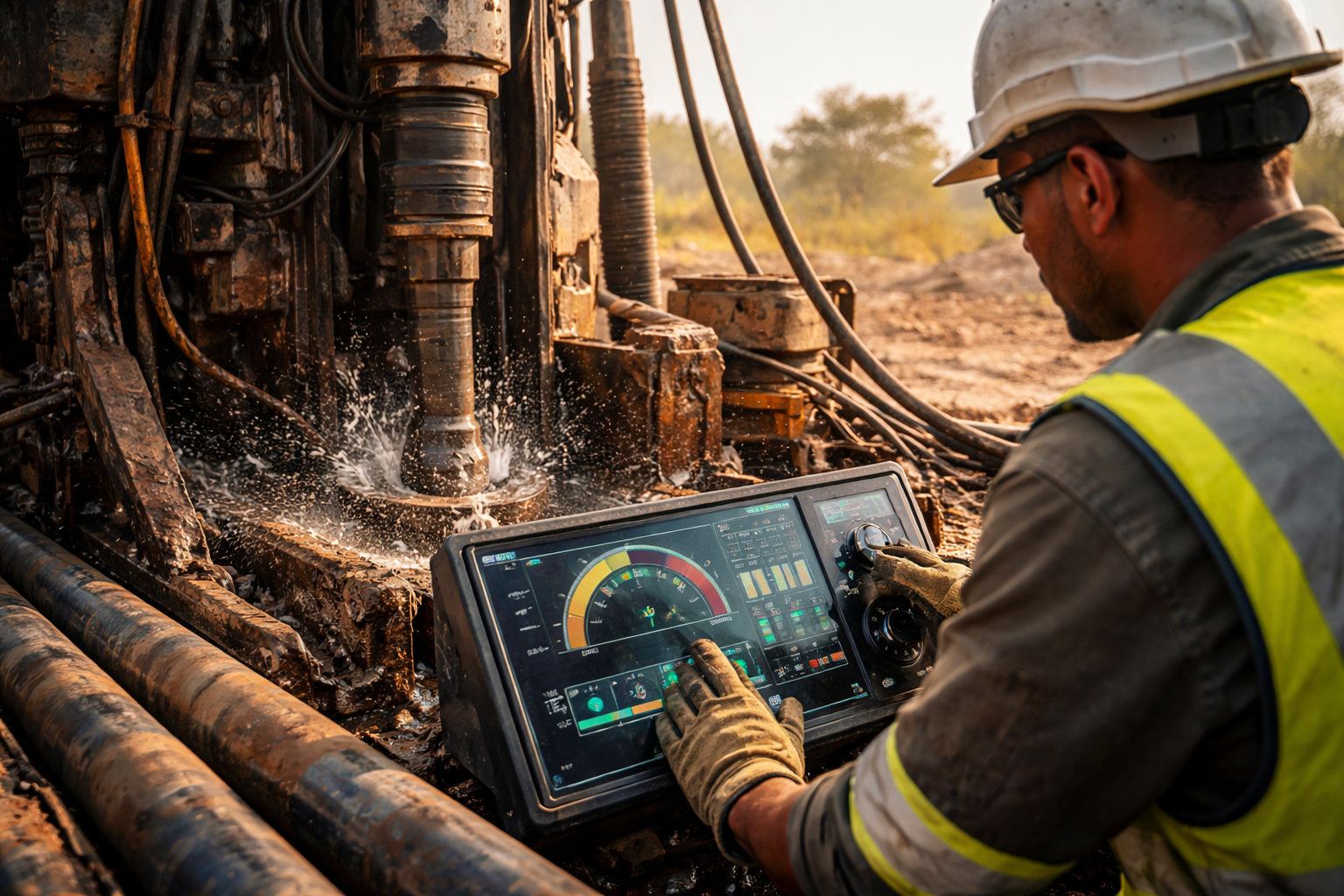
RPM, Feed, and Torque Discipline: The Parameter Control System That Stabilises Cost-Per-Metre on African Drill Sites
A programme is on pace. Metres are advancing. Shift reports look acceptable.
Then torque begins to rise.
Vibration increases slightly. Nothing dramatic. The driller adds feed pressure to keep penetration rate consistent. Core begins to fragment in the barrel. Breakout feels tighter than usual. Threads show light heating.
By the next shift, penetration rate drops. A rod joint binds. Half a shift is lost freeing the string. Recovery declines in the fractured interval. Consumable wear accelerates. The weekly report records “ground conditions” and “minor mechanical delay.”
What actually happened was parameter drift.
Most mechanical failures, rod damage events, and recovery losses are preceded by signals. Rising torque. Changing vibration patterns. Subtle shifts in return flow. These are not random anomalies. They are early warnings that drilling parameters have moved outside a stable operating window.
Drilling parameter control Africa operations require is not about operator instinct alone. It is a disciplined system. When RPM, feed, and torque are managed as a coordinated framework rather than independent adjustments, cost per metre drilling stabilises.
What Parameters Actually Control
Drilling stability is governed by three primary variables:
- Rotations per minute (RPM)
- Feed pressure
- Torque
Each variable influences the others. Adjusting one without considering the system creates instability.
RPM and Fragmentation
RPM controls how the bit engages the formation. In competent rock, appropriate RPM produces clean cutting and consistent core formation. In fractured or broken ground, excessive RPM increases vibration and micro-fracturing of the core.
High RPM in unstable ground often leads to:
- Core grinding rather than cutting
- Increased vibration
- Accelerated bit wear
- Rising torque as cuttings accumulate
To optimise RPM and feed drilling performance, RPM must match formation competency. More speed does not mean more metres. In unstable formations, controlled rotation reduces shock loading and improves recovery.
Feed Pressure and Core Integrity
Feed pressure governs penetration force. Excessive feed in fractured ground pushes broken fragments ahead of the bit, increasing jamming risk and wall collapse. Insufficient feed in competent ground causes bit polishing and reduced penetration rate.
Feed pressure directly affects:
- Core integrity
- Wall stability
- Bit face condition
- Vibration amplitude
Drillers often increase feed to maintain metres when torque rises. This compounds instability. Feed adjustments must respond to torque signals, not override them.
Torque as the Early Warning System
Torque discipline drilling practices treat torque as the primary health indicator of the hole.
Rising torque under constant RPM and feed suggests:
- Cuttings accumulation
- Wall instability
- Bit wear
- Increasing friction due to deviation or binding
Torque trend drift is more important than absolute torque value. A gradual increase over multiple runs indicates deteriorating stability long before a stuck string event.
When torque discipline drilling is embedded into shift culture, rod failure and breakout damage reduce significantly.
The Typical Mistakes That Create Downtime
Downtime rarely begins with a catastrophic event. It begins with small parameter decisions.
Chasing Penetration Rate Instead of Stability
Penetration rate is visible. Stability is not.
When crews focus exclusively on metres per shift, they often:
- Increase RPM in fractured ground
- Increase feed under rising torque
- Extend run length beyond stable limits
Short-term gains produce long-term instability. Drilling performance optimisation requires balancing rate and recovery.
Over-Correcting RPM in Fractured Ground
In broken formation, drillers sometimes drop RPM too drastically or increase it excessively in an attempt to compensate for poor recovery.
Both responses create:
- Irregular cutting
- Increased vibration
- Core wash
- Accelerated consumable wear
Stable, moderate adjustments are more effective than dramatic corrections.
High Feed in Broken Formation
Applying high feed pressure in shear zones forces fragments against the barrel and walls, increasing torque and binding risk. This is one of the most common contributors to prevent rod failure initiatives failing in fractured belts.
Feed must be reduced when entering visibly unstable intervals.
Ignoring Torque Trend Drift
Torque drift across multiple runs is often dismissed as “normal variation.”
But a consistent upward torque pattern signals:
- Increasing wall friction
- Accumulating cuttings
- Deteriorating hole condition
Ignoring this signal frequently precedes stuck string events.
Running Worn Consumables Too Long
Worn bits, reaming shells, and stabilising components amplify vibration and torque variability. Attempting to extract additional life from worn equipment often results in greater loss later.
Correctly matched consumable core drilling products support stable cutting and reduce unpredictable torque behaviour.
The Field Signals Crews Should Not Ignore
Experienced crews recognise that instability speaks before failure occurs.
Key signals include:
Rising Torque Under Constant RPM
If RPM and feed remain unchanged and torque rises progressively, the hole is deteriorating. Immediate evaluation is required.
Vibration That Changes Tone
A change in vibration sound or feel often indicates:
- Bit face glazing
- Uneven cutting
- Increasing wall contact
Operators should treat tonal changes as early instability indicators.
Intermittent Binding on Makeup and Breakout
If breakout becomes progressively tighter, thread stress is increasing. This often correlates with torque instability and misalignment.
Return Flow Changes
Reduced return flow or altered cuttings size distribution suggests cuttings retention. This increases friction and destabilises the hole.
Recovery Drop at Predictable Depths
Repeated recovery decline at similar depths indicates formation behaviour that requires parameter adaptation.
Drilling parameter control Africa operations require means recognising these patterns and responding consistently.
A Simple Parameter Control Protocol That Works
Parameter discipline must be procedural.
Establish a Stable Drilling Window
At the start of each interval, establish:
- Baseline RPM
- Baseline feed pressure
- Normal torque range
Log these values at shift start.
Respond to Torque First
If torque rises:
- Reduce feed slightly.
- Monitor torque response.
- If torque stabilises, maintain adjusted feed.
- If torque continues rising, reduce RPM moderately.
- Shorten run length if instability persists.
Never increase feed to counter rising torque.
Shorten Runs in Unstable Ground
In fractured intervals, shorter runs:
- Reduce cuttings accumulation
- Reduce wall degradation
- Improve recovery
- Limit torque escalation
Log Every Adjustment
Shift handovers must include:
- Torque trend notes
- Parameter adjustments made
- Recovery percentage
- Formation observations
Without documentation, drift repeats across shifts.
Consumables, Rigs, and Parameter Stability
Parameter control becomes easier when equipment supports stability.
Worn or mismatched components amplify vibration and torque variability. High-quality consumable core drilling products reduce cutting inconsistency and support stable parameter windows.
Rig alignment and structural rigidity also influence stability. Properly configured geotechnical drill rigs improve near-surface control in fractured formations.
In confined environments, suitable underground drill rigs provide better structural support and controlled torque transmission, reducing parameter fluctuation.
Equipment selection and parameter discipline are inseparable.
The African Context
African drill programmes frequently operate in:
- Structurally complex greenstone belts
- Deeply weathered near-surface formations
- Remote terrain with limited immediate technical support
- High-temperature, dusty environments
Extended freight timelines limit rapid replacement of damaged rods or consumables. Remote conditions increase the cost of mistakes.
Operator fatigue during long shifts can also reduce parameter vigilance.
In this context, drilling parameter control Africa operations require becomes critical. Formal protocols compensate for variable formation behaviour and human inconsistency.
Where response windows are long, prevention must be stronger.
Cost-Per-Metre Protection
Parameter discipline directly influences commercial outcomes.
Stable parameter management reduces:
- Re-drilling
- Rod failure
- Consumable burn rate
- Non-productive time
- Recovery losses
Each avoided rod failure prevents downtime. Each stabilised interval protects recovery. Each controlled torque trend preserves threads and breakout integrity.
Cost per metre drilling is not only determined by daily metres achieved. It is determined by:
- How many metres must be re-drilled
- How often rods must be replaced
- How many shifts are lost to instability
- How much recovery is compromised
Drilling performance optimisation is therefore not about drilling faster. It is about drilling within a stable parameter window consistently.
When RPM, feed, and torque are treated as a coordinated system, mechanical stress reduces, recovery improves, and downtime decreases predictably.
Parameter control is not an adjustment technique. It is a management system.
Frequently Asked Questions
What is the best way to control torque in diamond drilling?
The most effective method is monitoring torque trend drift rather than absolute values. When torque rises under constant RPM and feed, reduce feed first, then adjust RPM moderately. Never increase feed to overcome rising torque.
How do RPM and feed affect core recovery?
Excessive RPM in fractured ground increases fragmentation and vibration, reducing recovery. Excessive feed forces fragments into the barrel and destabilises walls. Balanced adjustments within a stable drilling window improve recovery.
What are the early warning signs of parameter drift?
Rising torque trends, changing vibration tone, tighter breakout, altered return flow, and consistent recovery decline at similar depths are all early signals of instability.
Does rig selection affect drilling stability?
Yes. Structural rigidity, alignment accuracy, and torque transmission characteristics influence vibration and parameter control. Properly configured rigs improve drilling stability and reduce mechanical stress.