Predictive Maintenance Signals on Drill Sites: What Early Failure Patterns Actually Look Like
Most drill rig failures do not begin with a loud mechanical snap.
They begin with a vibration that feels slightly different.
A torque reading that drifts unexpectedly.
A bearing housing that runs a few degrees hotter than usual.
Hydraulic oil that darkens gradually.
Reactive maintenance waits for visible failure.
Engineering-led maintenance detects signal drift before the failure event.
Predictive maintenance drilling rigs rely on disciplined signal recognition — not instinct, not guesswork, and not post-failure investigation.
In remote African drilling environments, where technician response time may stretch across hours or days, early detection is not a convenience. It is operational protection.
This Field Notes article examines what real early-stage failure signals look like on drill sites — and how structured observation reduces downtime, protects cost-per-metre, and stabilises long-term performance.
Failure Rarely Starts With a Bang
Catastrophic failures — snapped rods, seized pumps, burnt motors — are end-stage events.
Before the break:
- There was abnormal vibration.
- There was torque instability.
- There was heat creep.
- There was contamination.
- There was a log entry someone overlooked.
Predictive maintenance drilling rigs are not about installing more sensors. They are about recognising that mechanical systems degrade progressively — and that degradation produces detectable signals.
The challenge is cultural as much as technical:
Are those signals measured, recorded, and acted upon?
Vibration Indicators: The First Mechanical Whisper
Vibration is often the earliest mechanical warning.
Operators frequently notice it before instruments do:
- A subtle harmonic change.
- A slight shudder under load.
- Increased resonance during make-and-break cycles.
Common early vibration signals include:
- Bearing fatigue onset.
- Misalignment between components.
- Coupling imbalance.
- Increased stress from hole deviation.
In abrasive formations or deviated holes, bending stress increases oscillation. This vibration amplifies at threaded connections and rotating assemblies.
What It Actually Looks Like
Not violent shaking.
Instead:
- Slightly louder mechanical hum.
- Irregular oscillation under constant RPM.
- Increased operator fatigue from transmitted vibration.
If vibration trends upward gradually across shifts, it is rarely random.
Predictive maintenance drilling rigs treat vibration trends as actionable data — not background noise.
Torque Anomalies: When Parameters Drift Without Geological Cause
Torque is one of the clearest operational indicators — when interpreted correctly.
Under stable geology and controlled RPM:
Torque should remain predictable.
Warning signs include:
- Torque spikes without formation change.
- Inconsistent torque under constant load.
- Lag between torque input and system response.
- Gradual increase in baseline torque requirement.
These anomalies often precede:
- Thread deformation.
- Rod connection stress.
- Bit wear acceleration.
- String misalignment.
As explored in RPM & Torque Discipline, stable torque control is central to string integrity.
When torque drift is ignored, minor parameter instability becomes rod failure.
Predictive maintenance drilling rigs rely on baseline parameter mapping:
If you do not know what “normal” torque looks like for your formation and configuration, you cannot detect abnormal drift.
Heat Signatures: Thermal Patterns Before Breakdown
Heat does not spike suddenly in most mechanical systems.
It trends upward first.
Common early heat signals include:
- Bearing housing temperature creeping above historical baseline.
- Hydraulic oil temperature rising under normal load.
- Motor casing temperature imbalance.
- Electrical panel hotspots at connectors.
Thermal drift indicates:
- Increased friction.
- Lubrication breakdown.
- Internal resistance.
- Electrical inefficiency.
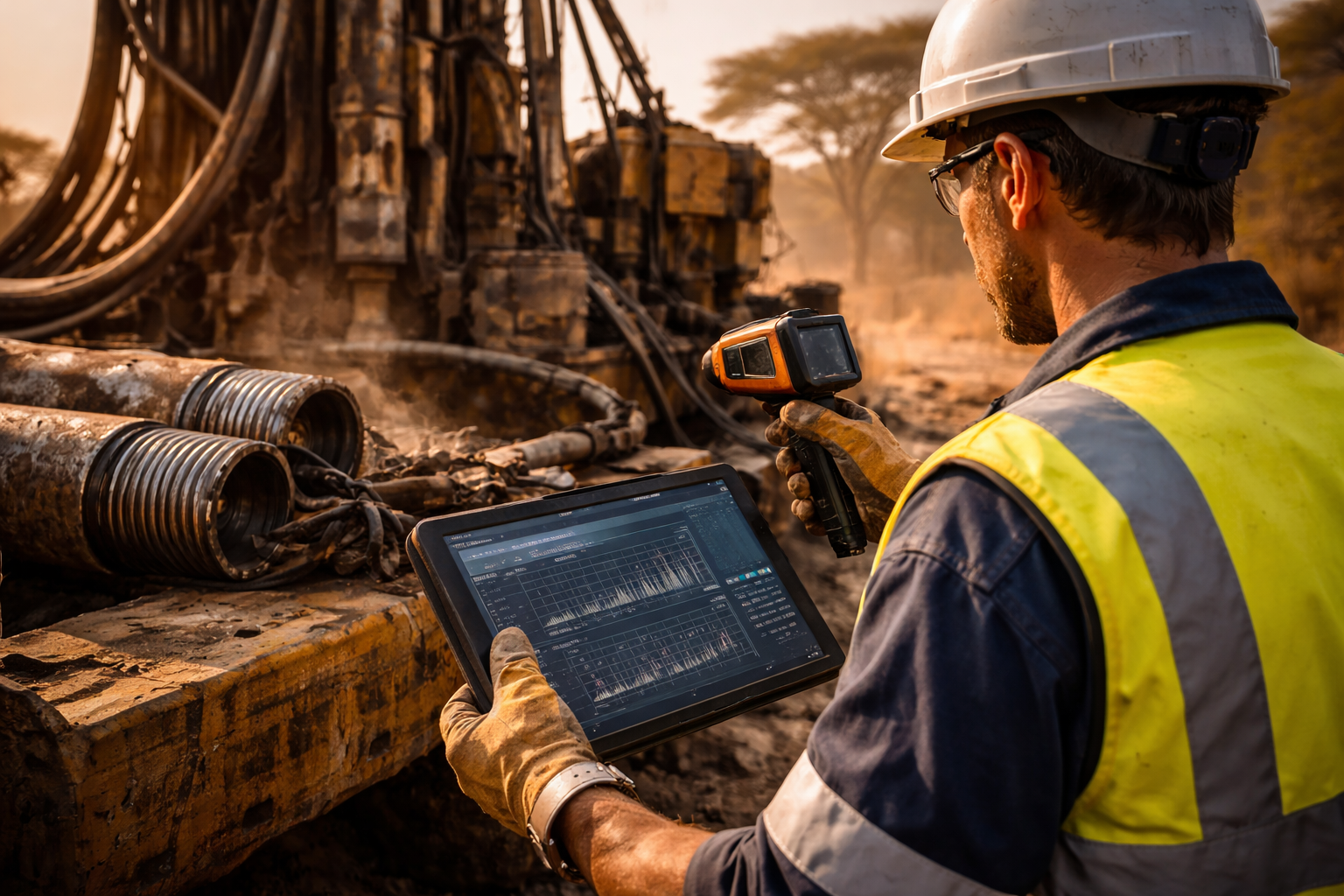
Even without advanced infrared cameras, disciplined manual temperature checks detect deviation.
Predictive maintenance drilling rigs focus on trends — not single readings.
If a component consistently runs 5–8°C hotter than last month under identical load, the system is communicating.
Hydraulic Contamination: Invisible Failure Catalyst
Hydraulic systems often fail long before visible damage appears.
Early contamination indicators include:
- Slight discoloration in fluid.
- Metallic shimmer under light.
- Fine particulate sediment.
- Delayed response in control systems.
- Pressure fluctuation under steady load.
Contamination originates from:
- Seal degradation.
- Wear particles.
- External dust ingress.
- Poor filtration discipline.
Hydraulic pump failure rarely happens without contamination warning.
Structured fluid sampling — even basic visual inspection — prevents catastrophic system collapse.
Predictive maintenance drilling rigs integrate fluid inspection into daily routine.
Daily Inspection Log Discipline
Early signals mean little without documentation.
Inspection logs must include:
- Vibration observations.
- Torque baseline deviations.
- Temperature readings.
- Fluid condition notes.
- Audible anomaly descriptions.
Each shift should:
- Record measurable data.
- Flag anomalies.
- Compare against prior entries.
- Escalate trends — not just events.
Maintenance log discipline transforms scattered observations into predictive intelligence.
Without log discipline:
- Anomalies are normalized.
- Trends go unnoticed.
- Signal becomes background noise.
And when failure occurs, it is labeled “unexpected.”
The Psychology of Signal Neglect
One of the most dangerous phrases on a drill site is:
“It’s still working.”
Normalisation of deviation occurs when:
- Schedule pressure dominates.
- Minor anomalies are tolerated.
- Downtime avoidance overrides caution.
- Crews adapt to worsening conditions.
Predictive maintenance drilling rigs require a culture that treats small deviations as early-stage warnings — not inconveniences.
Ignoring early vibration or torque drift may save an hour today and cost two days next week.
Escalation Timing and Technician Response
Early detection is only valuable if escalation follows.
Linking inspection logs to structured escalation reduces MTTR.
For example:
- Minor torque anomaly logged Day 1.
- Escalation review Day 2.
- Inspection and minor correction Day 3.
- Catastrophic rod failure avoided Day 10.
If escalation waits until failure:
Technician response becomes reactive.
As discussed in Technician Response, delayed intervention amplifies downtime cost.
Predictive maintenance drilling rigs shorten the gap between detection and correction.
Cost-Per-Metre Implications
Consider a scenario:
One rod failure avoided.
One hydraulic pump saved.
Two days of downtime prevented.
Multiply across a six-month campaign.
Even a 5% reduction in catastrophic failures:
- Reduces emergency freight.
- Reduces NPT.
- Protects production rhythm.
- Stabilises cost-per-metre.
Predictive systems protect output consistency.
In long-duration drilling programs, small prevention gains compound.
African Operating Realities Amplify Risk
Drilling conditions across remote terrain introduce compounding stress:
- High ambient heat accelerates seal degradation.
- Dust infiltration increases bearing wear.
- Long technician travel times delay response.
- Limited spare inventory increases repair timelines.
- Power instability increases motor stress.
Signal detection becomes more valuable where:
- Response is slower.
- Replacement is delayed.
- Logistics are complex.
Predictive maintenance drilling rigs are particularly critical in remote African operations where reactive repair timelines are extended.
What Early Failure Patterns Actually Look Like
In summary, early failure rarely appears as obvious damage.
It appears as:
- A bearing housing slightly warmer.
- A torque reading drifting gradually upward.
- A vibration pattern slightly more irregular.
- Hydraulic fluid slightly darker.
- A recurring minor anomaly in daily logs.
These are engineering signals.
They are measurable.
They are documentable.
And when recognised, they are preventable.
Field Notes Close
Mechanical systems communicate before they fail.
Vibration.
Torque drift.
Heat creep.
Fluid contamination.
Log patterns.
Predictive maintenance drilling rigs are not defined by sophisticated software alone.
They are defined by:
- Signal awareness.
- Documentation discipline.
- Escalation clarity.
- Engineering culture.
Before the next breakdown occurs, review your inspection logs.
The warning may already be recorded.
Frequently Asked Questions
1. What is predictive maintenance in drilling?
Predictive maintenance in drilling involves identifying early mechanical and parameter signals — such as vibration, torque drift, heat, and contamination — to intervene before catastrophic failure occurs.
2. What are early signs of drill rig failure?
Early signs include abnormal vibration, unexplained torque variation, gradual temperature increase, hydraulic contamination, and repeated minor anomalies recorded in inspection logs.
3. How does vibration indicate mechanical issues?
Increased or irregular vibration often signals bearing wear, misalignment, imbalance, or stress from hole deviation before visible damage occurs.
4. Why is torque monitoring important?
Torque drift can indicate thread stress, misalignment, bit wear, or string fatigue. Monitoring baseline torque helps detect early mechanical instability.
5. How often should inspection logs be reviewed?
Inspection logs should be completed every shift and reviewed daily by supervisors to identify trends and escalate emerging anomalies before failure develops.