The Silent Drift – Mastering Borehole Deviation in Deep-Hole Programmes
In exploration, a straight line is the shortest distance to a bankable feasibility study. However, once a drill string passes the 300-metre mark, it ceases to behave like a rigid rod and begins to act like a piece of wet spaghetti.
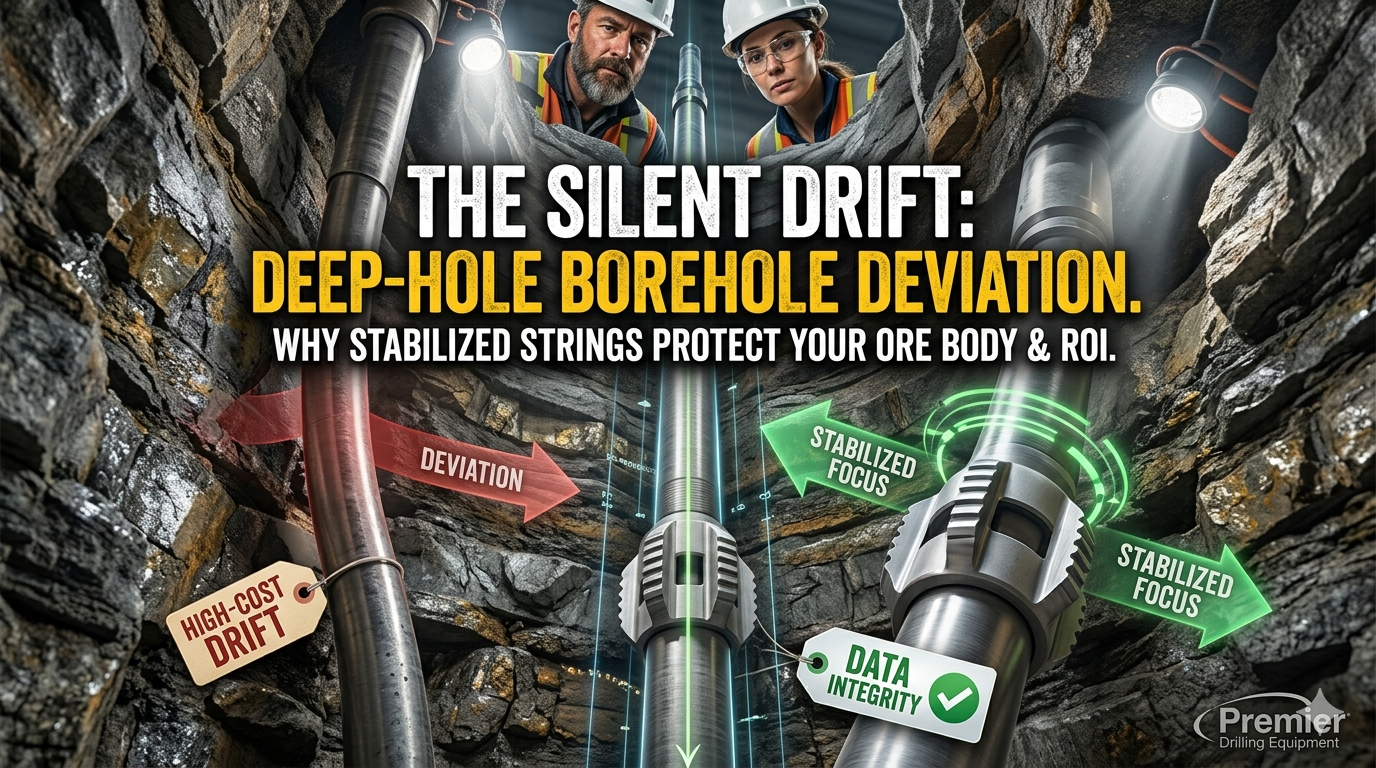
Borehole Deviation—the tendency of a hole to “walk” or “corkscrew” away from its intended target—is one of the most expensive “invisible” problems on a drill site. If a hole drifts by just 3 degrees over 1,000 metres, your intercept could be 50 metres off-target. In a narrow-vein gold or platinum environment, that is the difference between hitting the reef and hitting waste rock.
At Premier Drilling Equipment, we view deviation control as a combination of physics, metallurgy, and discipline.
Why Holes Walk: The Mechanics of Deviation
Deviation isn’t usually caused by a single factor, but rather a “perfect storm” of variables:
- Formational Dipping: Bits naturally want to drill perpendicular to the rock layers. If the strata are dipping steeply, the bit will “climb” the formation.
- Excessive Weight on Bit (WOB): Pushing too hard on a flexible string causes it to bow. Once the string bows, the bit face tilts, and the deviation begins.
- String Harmonics: Unstabilised vibrations (as discussed in previous Field Notes) create a centrifugal force that “whips” the bit off-centre.
The Premier Solution: Rigidity and Stabilisation
To fight deviation, you must increase the stiffness of the Bottom Hole Assembly (BHA). We achieve this through three specific technical interventions:
- Precision-Balanced Heavy Duty Subs: By using subs with exact concentricity, we eliminate the “wobble” that initiates drift at the top of the BHA.
- Parallel-Wall Rod Technology: Our rods are engineered with consistent wall thickness. Any eccentricity in a drill rod act as a “hinge” point for deviation; Premier rods maintain a straight axis even under high torsional loads.
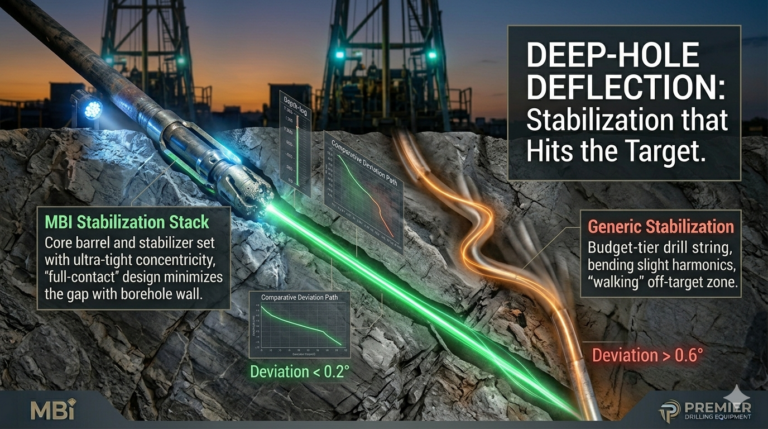
- Strategic Stabiliser Placement: We don’t just provide stabilisers; we advise on placement. Using a “Near-Bit” stabiliser coupled with a “Pony” stabiliser 3 metres back creates a rigid “mandrel” effect that forces the bit to maintain its trajectory.
[Image showing a comparison between a deviating “bowed” string and a stabilised Premier BHA]
The Cost of a “Crooked” Hole
Beyond missing the ore body, a deviating hole creates massive mechanical drag. As the hole curves, the friction between the drill rods and the borehole wall increases exponentially. This leads to:
- Premature Rod Wear: High-side wear on the joints.
- Increased Fuel Consumption: The rig has to work harder just to turn the string.
- Stuck Pipe Risk: The “dog-leg” severity can become so sharp that the rods eventually wedge in the hole.
Field Note: The 50-Metre Rule
Don’t wait until the end of the shift to check your survey data. If you notice a deviation trend of more than 0.5 degrees per 50 metres, stop. Check your inner tube stabiliser wear and reduce your WOB. It is always faster to pull the string and adjust your BHA than it is to wedge-drill a correction later.
Conclusion: Data You Can Trust
A hole that hits the target on time and on budget is the ultimate hallmark of a professional drilling programme. By using Premier’s stabilised assemblies and high-tensile rods, you aren’t just making a hole—you’re ensuring that the “Digital Twin” of your ore body matches the reality in the ground.