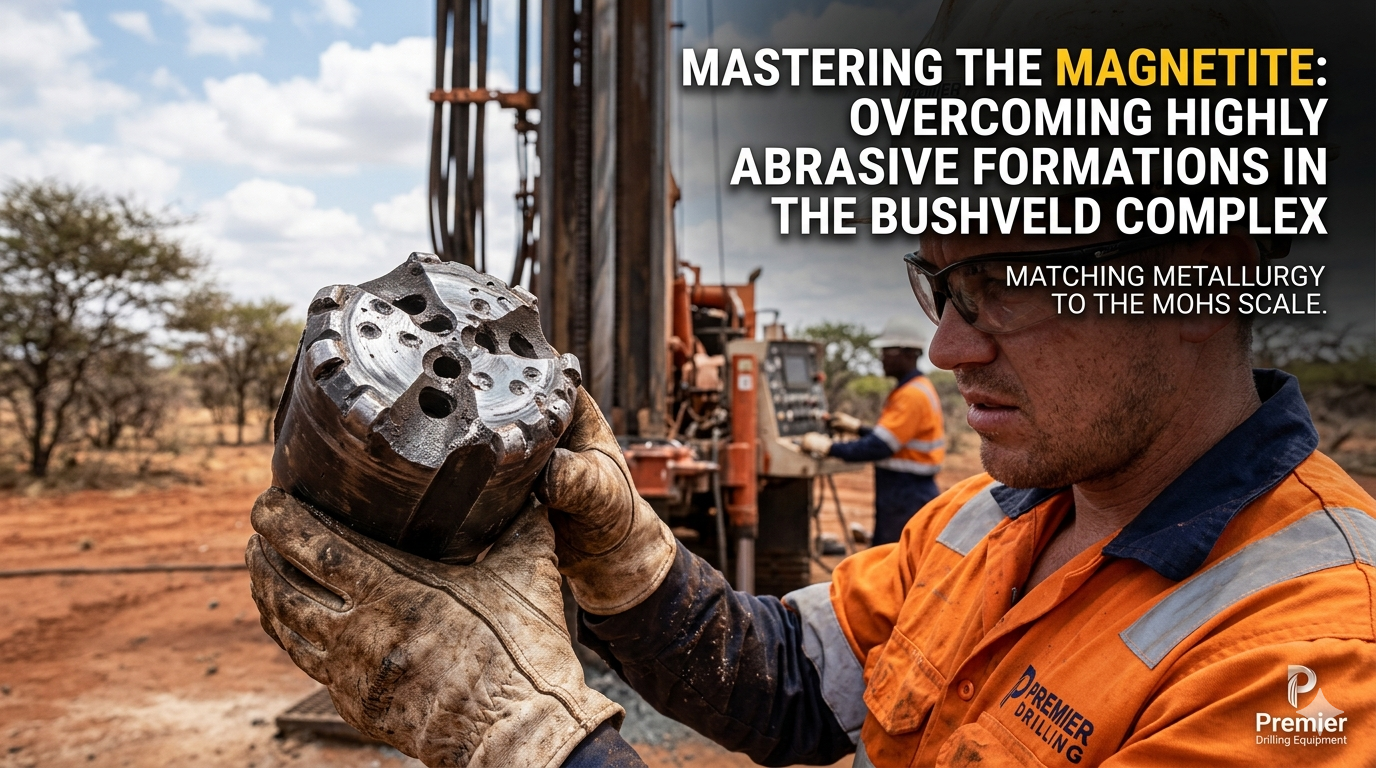
Mastering the Magnetite – Overcoming Highly Abrasive Formations in the Bushveld Complex
If you’ve operated a rig within the Eastern or Western Limbs of the Bushveld Complex, you know that the “sandpaper effect” isn’t a metaphor—it’s a line item on your balance sheet. When drilling through magnetite-rich layers or high-silica contact zones, the geological reality is unforgiving. These formations don’t just wear down your bits; they attack the entire drill string, from the gauge of the diamond bit to the wall thickness of your inner tubes.
At Premier Drilling Equipment, we’ve spent over a decade observing how these specific South African conditions turn high-performance tools into scrap metal in record time. Success in these environments isn’t about brute force; it’s about matching the metallurgy to the Mohs scale.
The Challenge: Beyond Rock Hardness
While the Vickers or Mohs hardness of magnetite is significant, the real killer is abrasivity. In mineral exploration, we often see drillers struggle with “polishing.” This occurs when the rock is hard enough to wear away the diamonds but not abrasive enough to strip away the metal matrix.
However, in the Bushveld’s magnetite-rich zones, we often face the opposite: the matrix is stripped away too fast, dropping diamonds before they’ve done their job. This leads to high bit costs and constant tripping, which destroys your ROP (Rate of Penetration).
Matrix Science: The Self-Sharpening Balance
To overcome this, the selection of your diamond bit matrix is the most critical decision you’ll make before collars go into the hole.
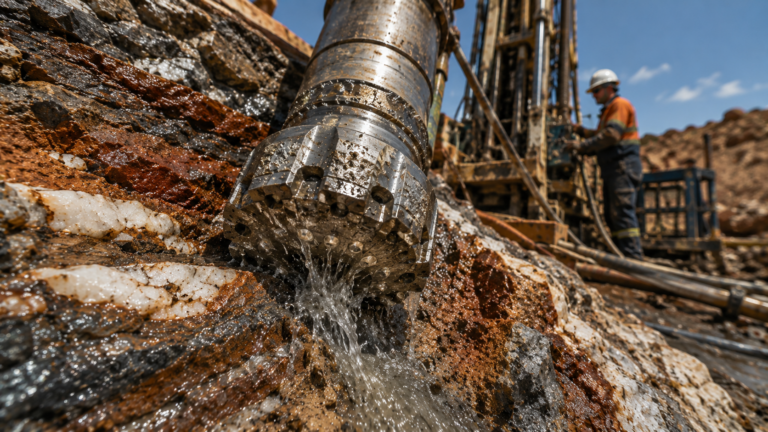
For highly abrasive, hard formations, moving to a higher-series matrix (e.g., a Series 9 or 10) is often the standard move. These matrices are designed with a harder, more resilient bond that holds the diamonds longer against the scouring action of magnetite cuttings. The goal is “controlled erosion”—the matrix must wear at a rate that consistently exposes fresh, sharp diamond points without shedding them prematurely.
The “Hidden” Wear: Inner Tubes and Stabilizers
Abrasive ground doesn’t stop at the bit face. One of the most overlooked costs in Bushveld drilling is the premature failure of inner tubes.
As magnetite and silica cuttings are flushed up the hole, they act as a grinding paste between the inner and outer tubes. If you are using standard-wall tubing in these conditions, you risk a “washout” or a structural collapse of the tube, which can lead to core blockage or, worse, a lost inner tube assembly.
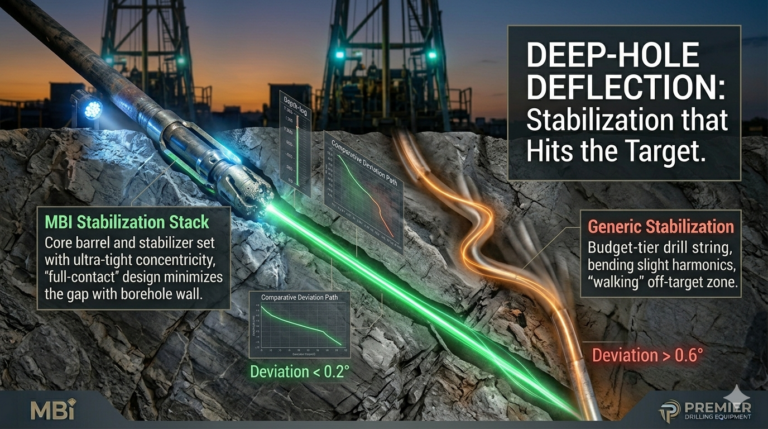
We recommend using heavy-duty, hard-chromed, or nitrided inner tubes for these specific programmes. Furthermore, ensuring your stabilizers are fitted with premium Tungsten Carbide inserts is non-negotiable. If your stabilizers lose gauge, your hole will begin to deviate, leading to increased torque and an eventual stuck pipe.
The Math of Matrix Selection
Consider the cost-per-metre:
- Option A: A cheaper, lower-series bit lasts 40 metres before the matrix is stripped.
- Option B: A premium, high-series bit (costing 20% more) lasts 80 metres because the matrix is tuned to the abrasivity.
By doubling your bit life, you haven’t just saved the cost of a second bit; you’ve eliminated a full tripping cycle. In a 500-metre hole, that is hours of rig time returned to your bottom line.
Field Note: Polishing vs. Stripping
If your bit comes out looking “smooth” with the diamonds flush to the metal, you are polishing—your matrix is too hard. Use a sharpening stone or switch to a lower series. If the bit comes out with “craters” where diamonds used to be, you are stripping—your matrix is too soft for the abrasivity. Switch to a higher series immediately.
Conclusion: Engineering for the Complex
Drilling the Bushveld Complex requires a partner who understands that a bit isn’t just a bit. It is a technical response to a geological challenge. By focusing on matrix resilience and protecting your string from abrasive wear, you shift the “Total Drilling Cost” back in your favour.
Premier Drilling Equipment stocks the specific series and heavy-duty hardware required to turn magnetite from a nightmare into a manageable metric.