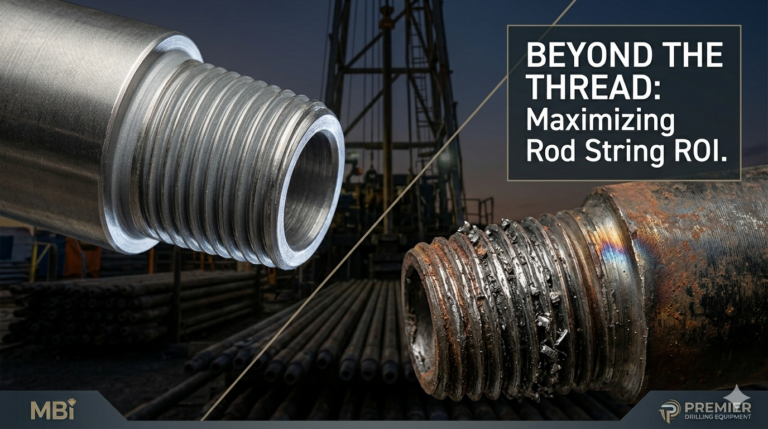
The Silent Thread Killer – Preventing Galling in High-Torque Drill Strings
It usually happens during a routine breakout. The iron roughneck applies torque, the joint refuses to budge, and when it finally snaps open, the damage is visible: the steel threads are torn, smeared, and fused. You’ve just experienced galling—a form of “cold welding” that can retire a R50,000 drill pipe in a single shift.
In the high-pressure environment of South African mineral exploration, where we push strings to their torsional limits, thread integrity is not a suggestion; it is a survival trait. At Premier Drilling Equipment, we don’t just cut threads; we engineer them to resist the microscopic friction that leads to macroscopic failure.
The Physics of the “Cold Weld”
Galling occurs when the protective oxide layer on the surface of the steel threads is breached under intense pressure. Without this layer, the “high points” of the metal surfaces make direct contact. The resulting friction generates enough localised heat to cause the molecules to bond—effectively welding the pin and box together.
While budget-grade pipes often feature rougher, “as-machined” thread profiles, Premier’s API-spec threads undergo a precision finishing process. By reducing the initial surface roughness (Ra value), we lower the friction coefficient, significantly decreasing the likelihood of metal-to-metal fusion during high-torque make-up.
The Grease Factor: Why Standard Lubricants Fail
If you are using “general-purpose” grease on your drill string, you are inviting disaster. High-torque threads require a dedicated Copper-based Thread Compound.
The copper flakes act as a physical barrier—a sacrificial layer that stays between the steel surfaces even when the lubricant’s base oil is squeezed out by the immense pressure of the joint. In the deep holes of the Bushveld or the Northern Cape, where temperatures and pressures climb, this metallic barrier is the only thing preventing a permanent bond.
The Prevention Protocol: Three Non-Negotiable Steps
To maximise the ROI of your drill string, your rig crew must follow a strict “Thread Life” programme:
- The Virgin Break-in: New threads are at their most vulnerable. A new pipe should be made up and broken out three times at reduced torque (approximately 60% of the operating limit) with a fresh coat of compound each time. This “burnishes” the threads, smoothing out microscopic burrs in a controlled environment.
- Meticulous Cleaning: Sand and magnetite cuttings are abrasives that accelerate galling. Threads must be cleaned with a stiff brush and solvent—not just wiped with a rag—before every make-up.
- Controlled Torque: Over-torquing is just as dangerous as under-torquing. Use a calibrated torque wrench to ensure the shoulders meet the exact specification. An over-tightened joint stretches the threads, causing “pitch mismatch” which is a primary precursor to galling.
Field Note: The ‘Go/No-Go’ Visual Inspection
Before every shift, inspect the Thread Shoulders.
- Green Light: The shoulder is flat, smooth, and shows an even distribution of grease.
- Red Light: You see “rolled” metal on the shoulder or “shaved” steel in the thread roots. This joint is compromised. Running a galled thread into a healthy box will “infect” the entire string. Retire the pipe immediately for re-cutting.
Conclusion: Engineering for Zero-Downtime
A galled thread is more than a damaged part; it is a logistical failure that stops the rig. By investing in the precision-cut threads provided by Premier Drilling Equipment and adhering to a rigorous maintenance protocol, you move from reactive repairs to proactive production.
In the drilling world, the best joint is the one you never have to think about. We provide the engineering; your crew provides the discipline. Together, we keep the string turning.