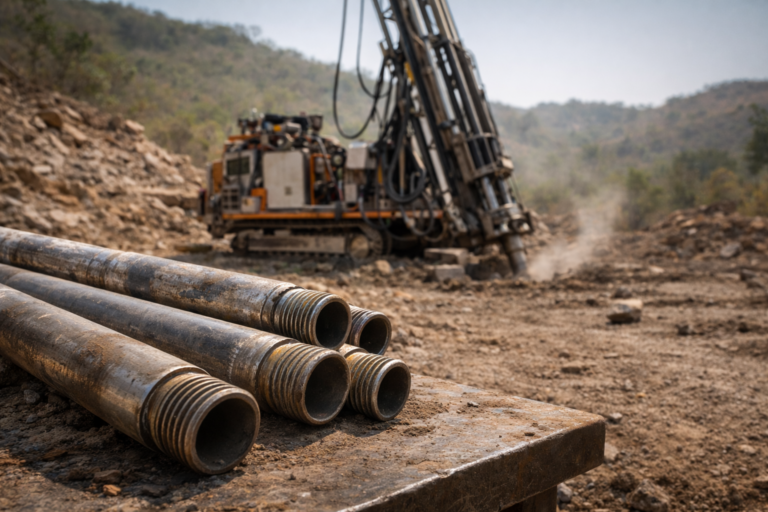
Remote Mobilisation Playbook: Planning Drill Campaign Logistics in Harsh African Terrain
Mobilisation is often described as a transport phase.
Load the rig.
Move it to site.
Start drilling.
In reality, across much of the continent, remote drilling logistics Africa operations depend on is not a transport exercise — it is a continuity engineering exercise.
Campaigns are delayed not because rigs cannot drill, but because:
- Border paperwork stalls
- Critical spares arrive late
- Roads become impassable
- Seasonal rains isolate access routes
- Fuel supply chains fail
- One failed component waits days for replacement
Mobilisation decisions made before the first metre is drilled often determine cost-per-metre stability for the entire program.
This Field Notes playbook reframes mobilisation as a structured engineering phase designed to reduce non-productive time (NPT) and protect output continuity.
Mobilisation Is an Engineering Phase
When a drill campaign is approved, the first measurable risk begins before the rig moves.
Remote drilling logistics Africa operations must account for:
- Border friction
- Infrastructure limitations
- Weather variability
- Long resupply chains
- Limited technical density
- Fuel and power instability
If mobilisation planning focuses only on transport cost and route selection, risk exposure remains high.
Engineering mobilisation means asking:
- What failure scenarios occur before drilling begins?
- What parts cannot fail during first deployment?
- What redundancy must be built in?
- What is the acceptable delay threshold?
Mobilisation engineering protects:
- Crew productivity
- Cost-per-metre targets
- Equipment lifespan
- Project timelines
Border Clearance Timelines and Regulatory Friction
Cross-border drill campaigns are common in Southern and Central Africa. Yet clearance variability is often underestimated.
Typical variables include:
- Temporary import permits
- Customs inspection cycles
- Carnet or bonded cargo requirements
- VAT documentation
- Port congestion
- Administrative backlog
Even minor paperwork errors can delay clearance by days.
Engineering Approach to Border Risk
Mobilisation plans should include:
- Duplicated documentation (digital and hard copy)
- Advance customs pre-clearance where possible
- Broker alignment before dispatch
- Buffer days built into schedule
- Escalation contacts mapped in advance
Without schedule buffers, crews arrive before rigs.
Idle crews inflate cost-per-metre before drilling begins.
In remote drilling logistics Africa campaigns, documentation discipline is as critical as mechanical preparation.
Critical Spare Duplication: Engineering Redundancy
The most common mobilisation mistake is shipping only operational equipment and minimal spares.
Mobilisation must assume component failure.
Critical spare duplication should include:
- Hydraulic pump seals
- Electrical relays and regulators
- High-wear consumables
- Sensor components
- Control system backups
- Thread repair tools
Classification helps:
Category A – Mission-critical, no local substitute
Category B – Replaceable but delays possible
Category C – Non-critical
Category A items must travel with the rig.
Waiting for cross-border freight in remote drilling logistics Africa environments can extend downtime by 3–7 days or more.
This aligns directly with structured Inventory Strategy principles — stocking must reflect lead-time risk, not convenience.
Redundancy is not excess cost.
It is downtime prevention.
Seasonal Access Planning
Seasonality transforms transport routes.
Across various regions, rainy season may bring:
- Washed-out gravel roads
- Flooded low-water bridges
- Mud-locked access tracks
- Reduced heavy vehicle mobility
Heat cycles can also:
- Increase tyre failure
- Stress cooling systems
- Accelerate hydraulic degradation
Mobilisation engineering must include:
- Historical weather data review
- Alternate route mapping
- Staged inventory before seasonal onset
- Weather-based schedule adjustments
- Access window modelling
Ignoring seasonality exposes campaigns to:
- 2–10 day unplanned access loss
- Fuel delivery interruption
- Crew isolation
Remote drilling logistics Africa planning must treat weather as a logistical variable — not a surprise.
Air vs Road Freight Risk Modelling
Transport decisions must balance cost against continuity risk.
Road Transport
Advantages:
- Lower direct cost
- Higher load capacity
- Flexible routing
Risks:
- Border delay
- Mechanical breakdown
- Weather exposure
- Security checkpoints
- Fuel availability variability
Air Freight
Advantages:
- Speed
- Reduced border delay exposure
- Rapid part replacement
Constraints:
- Limited weight capacity
- Higher cost
- Runway accessibility
- Weather sensitivity
Engineering mobilisation requires defined thresholds:
- Which parts justify air freight?
- At what downtime risk does flying become economical?
- Which rigs require modular transport planning?
Heliportable or modular rigs reduce exposure where terrain is restrictive — tying directly into Drill Rig Selection decisions.
Freight decisions should be pre-modeled, not improvised mid-campaign.
Contingency Matrices: Structured Risk Planning
A contingency matrix formalises response.
Each mobilisation plan should document:
| Risk | Probability | Impact | Mitigation | Estimated Delay |
|---|
Common categories:
- Border clearance delay
- Mechanical failure during transit
- Fuel supply interruption
- Seasonal weather blockage
- Power supply instability
- Parts stockout
- Security restriction
- Communications outage
Without a contingency matrix, teams react emotionally.
With one, response becomes structured.
This reduces NPT exposure — aligning with the operational stability themes in NPT in African Drill Programs.
Mobilisation engineering reduces surprise variables.
Camp Infrastructure and Early Deployment Engineering
Mobilisation success depends on site readiness.
Before rig arrival, confirm:
- Generator capacity installed
- Power cables and distribution panels prepared
- Water storage capacity sufficient
- Fuel storage compliant and adequate
- Tool storage protected from dust and moisture
- Environmental controls in place
If the rig arrives before infrastructure readiness:
- Installation delays occur
- Setup time increases
- Equipment stress increases
- Early downtime risk rises
Remote drilling logistics Africa planning must integrate camp engineering with transport scheduling.
Fuel and Energy Planning
Energy instability can interrupt mobilisation and early operations.
Before deployment:
- Validate generator capacity
- Confirm fuel supply contracts
- Ensure backup power availability
- Assess voltage stability
- Plan surge capacity
Transporting a rig into an energy-constrained camp delays start-up and increases mechanical stress.
Power planning must be part of mobilisation — not an afterthought.
The Cost-Per-Metre Impact
Mobilisation inefficiency compounds rapidly.
Example scenarios:
- 3-day border delay before drilling begins
- 4-day spare part delay due to understocking
- 5-day weather blockage
- 10% seasonal productivity loss
These delays inflate:
- Fixed crew cost
- Equipment standby cost
- Camp operating cost
- Fuel overhead
- Administrative overhead
Cost-per-metre increases before drilling stabilises.
Remote drilling logistics Africa operations must model these variables early to prevent cascading economic impact.
Mobilisation engineering is cost control.
African Terrain Realities
Across the continent, drilling campaigns encounter:
- Remote bushveld
- Desert corridors
- Mountain passes
- Long gravel haul routes
- Limited mechanical support density
- Sparse communications infrastructure
These realities mean:
- Minor breakdowns become major delays
- Freight flexibility is limited
- Spare lead times increase
- Recovery options narrow
Structured mobilisation reduces exposure.
Unstructured mobilisation magnifies risk.
Mobilisation as Production Protection
Treat mobilisation as:
- A system integration phase
- A risk modelling exercise
- A redundancy planning process
- A schedule stabilization tool
Not merely:
- A trucking contract
- A dispatch date
Remote drilling logistics Africa conditions demand proactive engineering before movement begins.
Mobilisation discipline protects:
- Timeline
- Cost-per-metre
- Crew productivity
- Equipment longevity
- Client confidence
Field Notes Close
Mobilisation is the first operational test of any drilling campaign.
Border clearance must be engineered.
Critical spares must travel with the rig.
Seasonality must shape schedule.
Freight mode must be risk-weighted.
Contingency matrices must be documented.
Camp readiness must precede arrival.
When mobilisation is engineered, drilling starts smoothly.
When mobilisation is improvised, downtime begins before the first metre is drilled.
Before your next campaign, review your mobilisation plan with the same discipline you apply to consumables lifecycle control and parameter management.
Because in harsh terrain, continuity is engineered — not hoped for.
Frequently Asked Questions
1. How long does drill rig mobilisation take in Africa?
Mobilisation timelines vary widely depending on distance, border crossings, terrain, and regulatory requirements. Structured planning with buffer days significantly reduces unexpected delays.
2. What spares should travel with a drill rig?
Mission-critical hydraulic, electrical, and sensor components should accompany the rig, along with high-risk consumables and diagnostic tools to reduce downtime exposure.
3. How do seasonal rains affect drilling logistics?
Seasonal rains can restrict road access, flood crossings, delay freight, and isolate camps. Mobilisation schedules should account for seasonal access windows and pre-position inventory before rainy periods.
4. When should air freight be used instead of road transport?
Air freight is appropriate for high-impact, low-weight components where downtime cost exceeds freight premium. Decision thresholds should be pre-modeled during mobilisation planning.
5. How does mobilisation impact cost-per-metre?
Mobilisation inefficiencies increase fixed operating costs before production stabilises. Delays in equipment arrival, spare parts, or site readiness inflate cost-per-metre throughout the campaign lifecycle.