Fishing for ROI – Why High-Spec Overshots are Your Best Insurance Policy
It is the gut-punch every driller knows. You’re hauling the wireline, expecting the familiar weight of a full inner tube, and suddenly the line goes slack. Somewhere 400 metres down, a spearhead has snapped, a split pin has sheared, or a dry hole has caused a disconnect.
In that moment, your rig isn’t a production machine anymore—it’s a very expensive recovery crane. The “Total Drilling Cost” of a lost inner tube assembly isn’t just the price of the hardware; it’s the four, eight, or twelve hours of non-productive time (NPT) spent “fishing” while the client watches the clock.
At Premier Drilling Equipment, we treat recovery tools not as afterthoughts, but as high-stakes insurance policies. If you have to go into the hole to get something back, you need to know the tool will engage the first time, every time.
The Anatomy of a Precision Recovery
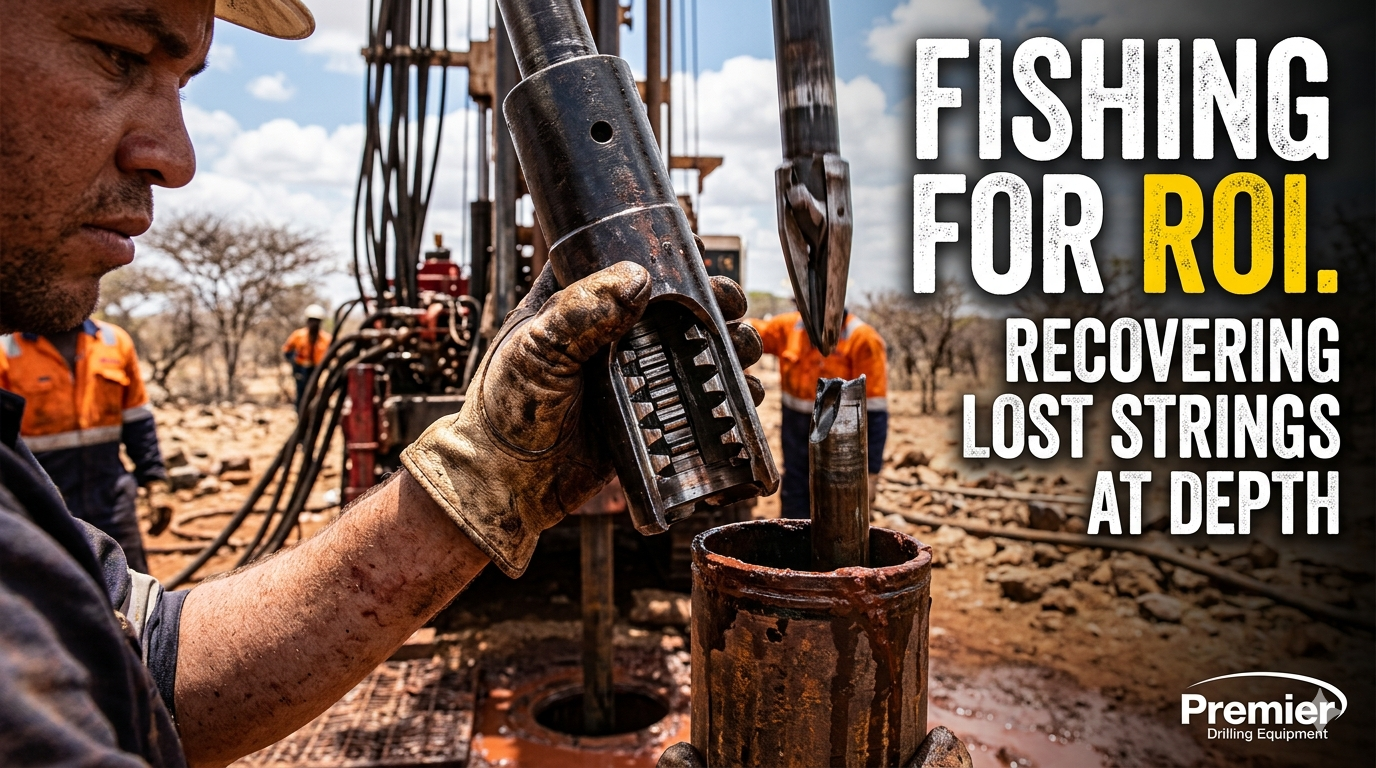
An overshot is a deceptively simple tool that operates in a violent environment. It must descend through drilling mud, navigate borehole deviations, and snap onto a spearhead with mechanical certainty.
The failure point in “budget” overshots is almost always the Lifting Dogs. If these are cast from inferior alloys, they can chip or round off during a hard engagement. If the dogs don’t bite clean, you risk “dropping the fish”—sending the inner tube back to the bottom with even more force, potentially wedging it permanently or damaging the core bit.
Premier’s overshots feature case-hardened, precision-ground lifting dogs. This metallurgy ensures the “teeth” of the tool maintain their sharp profile even after multiple high-impact engagements in abrasive environments.
The Engineering of Reliability: Why Springs Matter
The “heartbeat” of an overshot is its internal spring system. The spring must be strong enough to force the dogs closed under the weight of the mud column, yet flexible enough to allow the spearhead to enter the assembly.
Cheap overshots often use standard-grade springs that lose their “memory” after being compressed in high-temperature holes. A weak spring leads to a “mismake”—the tool reaches the bottom, but the dogs fail to snap shut. The driller pulls back, thinks they have the load, and the assembly disconnects halfway up the hole.
We utilise heavy-duty, fatigue-resistant springs specifically rated for deep-hole exploration. This ensures that the mechanical “click” of engagement is positive and permanent until the release sleeve is manually activated on the surface.
The Safety Aspect: Jarring and Wireline Integrity
Recovery is a high-tension operation. If an overshot becomes stuck or the “fish” is wedged, drillers often resort to “jarring”—using a slide hammer effect to break the assembly free.
During jarring, the thread connection between the overshot and the wireline jar is the primary failure point. Premier ensures that every recovery tool is machined with tapered API threads that match the high-torque specs of your string. This prevents thread-stripping under the intense upward shocks of a recovery mission.
Field Note: The 60-Second Spring Tension Test
Never send an overshot down the hole without this check:
- Manual Engagement: Insert a spare spearhead into the overshot on the rig floor.
- The “Shake” Test: Suspend the assembly and give it a sharp downward jerk. The dogs should stay locked without any lateral play.
- Spring Resistance: Use your thumb to depress the dogs. They should snap back instantly with a metallic “clack.” If the movement is sluggish or “mushy,” the spring is fatigued. Replace it before the next descent.
Conclusion: Getting Back What You Put In
In mineral exploration, the only thing more expensive than drilling a hole is drilling it twice because you couldn’t recover your gear.
By equipping your rigs with Premier’s high-spec overshots and recovery components, you are shortening the window of NPT. We build our tools to ensure that when you go “fishing,” you come back with the ROI you intended to pull from the ground.