The Technical Divergence: Evaluating Water Borehole vs. Core Drilling Rig Architecture in Sub-Saharan Terrains
In the challenging geological and infrastructure landscapes of Sub-Saharan Africa, the success of a drilling project depends on selecting equipment that matches the primary operational objective. For civil engineers, hydrogeologists, and consultants managing groundwater development or structural exploration, understanding the technical specifications of their fleet is critical.
While a drilling rig may look like a generic piece of heavy machinery, the underlying engineering architecture diverges sharply between water borehole drilling and mineral core drilling. Establishing high-flow groundwater extraction has fundamentally different technical priorities than extracting an intact geological sample. Understanding this divergence ensures that consultants and contractors utilize the correct hydraulic and structural parameters for their specific terrain, maximizing efficiency while protecting equipment longevity.
Technical Divergence 1: Structural Design – Torque vs. RPM
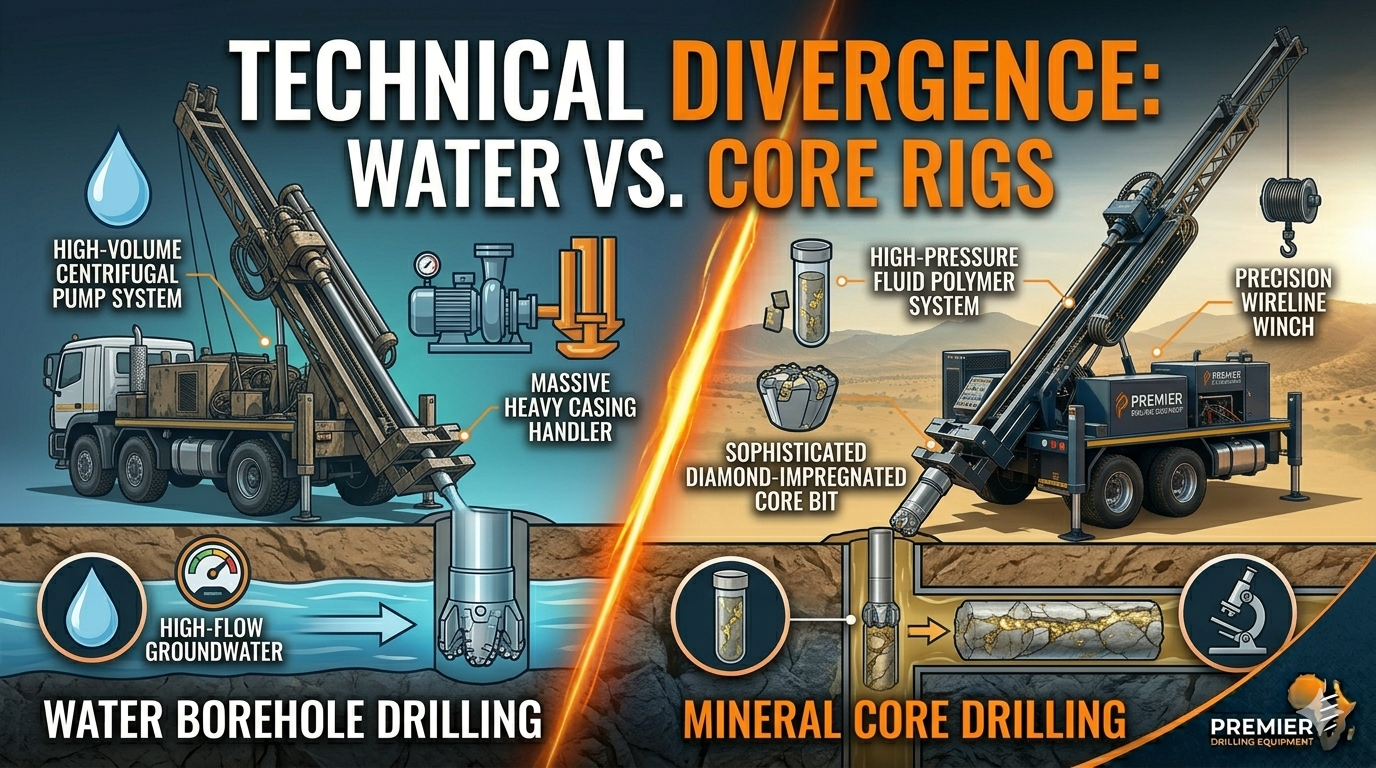
The mechanical priorities governing the rotation unit highlight the core difference between these two applications. Water rigs are engineered for powerful, large-diameter tricone or DTH (Down-the-Hole) hammer work, while core rigs are optimized for cutting rather than crushing.
Water Rigs: High Rotational Torque
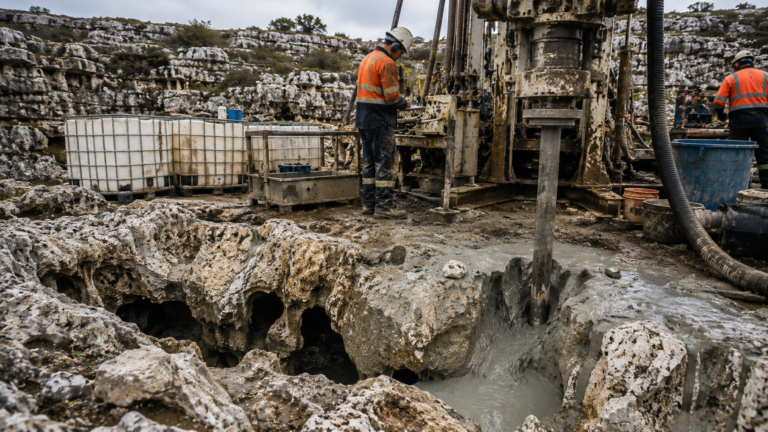
A hydrogeological project must deliver massive, stable boreholes through abrasive, variable formations to install multi-inch well casings. To handle large tricone bits, the rotation unit of a specialized water well rig must produce substantial hydraulic torque, enabling the rig to maintain rotation while managing significant cutting resistance. Water well rigs typically operate at relatively low speeds—under 200 RPM—relying on powerful pull-down force and high-torque mechanics to crush through rock.
Core Rigs: High-RPM Cutting
Mineral exploration demands precision, and standard Surface Drill Rigs utilized for diamond coring are customized for this goal. Their rotation units prioritize exceptional rotational speed (reaching 1200 RPM or more) rather than torque. The objective is to utilize the high surface speed of a diamond-impregnated bit matrix to efficiently cut, rather than crush, a smooth, high-quality core sample. Applying excessive torque to a diamond core bit will glaze or burn the matrix, halting production.
Technical Divergence 2: Hydraulics – Volume vs. Pressure
The divergence extends into the hydraulic fluid management systems. Both water and core drilling rely on a fluid medium to cool the bit and lift cuttings, but their specifications for pressure and volume are mismatched.
Water Rigs: High-Volume Centrifugal Hydraulics
Water borehole projects create massive 6- to 10-inch holes, translating to vast amounts of rock cuttings that must be rapidly evicted from the annulus. To manage this massive ‘cutting lift,’ water rigs require heavy-duty, high-volume centrifugal mud pumps capable of moving enormous fluid volumes (ranging from 1500 to over 3000 Litres per minute). The pressure requirement is generally moderate, as the goal is fluid movement rather than deep chemical encapsulation.
Core Rigs: High-Pressure Piston Hydraulics
Core drilling hydraulic systems are optimized for precision fluid delivery rather than bulk volume. Coring typically utilizes narrow boreholes (e.g., NQ, HQ wireline). In these tight annular spaces, fluid volume must be kept low (often under 150 L/min) to prevent excessive pressure buildup that could wash out sensitive formations or delicate mineralized zones. However, fluid pressure is critical. Core rigs utilize powerful piston pumps that deliver pressures exceeding 1000 PSI to maintain fluid velocity, ensuring that fine rock flour is cleared from the bit face efficiently without damaging the core sample.
Specialized Features and Equipment Longevity
The divergent architecture influences the physical configuration of the rig mast and on-site consumables.
Casing Management vs. Wireline Precision
Water borehole rigs are constructed with reinforced masts engineered for massive pull-up and pull-down capacity to manage the heavy, large-diameter steel well casings and long drill strings required for deep, high-flow production wells. Core rigs rarely handle heavy casing on this scale. In contrast, heavy-duty Surface Drill Rigs are equipped with sensitive, fast wireline winches. This specialized equipment is critical for efficiently retrieving the core-filled inner tube quickly without tripping the entire drill string, which never occurs on a standard water well site.
Consumables for Groundwater vs. Core Recovery
The choice of consumable core drilling products also diverges based on the hydraulic environment. Water well operators often prioritize simple bentonite mud systems or generic polymers to manage cutting lift and ensure borehole stability for casing installation. Mineral campaigns, conversely, demand highly technical fluid polymer systems tailored to specific rock chemistries and consumable core drilling products, such as diamond bits, configured specifically for maximum core recovery in complex or abrasive greenstone belts.
Conclusion: Matching Architecture to the Terrain
The civil and hydrogeological engineering sectors in Sub-Saharan Africa require high-performance drilling platforms, but success requires matching the machine’s inherent architecture to the project goal. Civil engineers must utilize high-volume hydraulics and high-torque machinery to deliver robust, high-flow groundwater infrastructure. Project geologists must utilize high-pressure hydraulics and high-RPM mechanics to preserve structural geological data.
Understanding this fundamental divergence allows consultants and asset managers to optimize operations, ensure maximum equipment longevity, and avoid the catastrophic failure events that occur when machinery is deployed outside of its designed engineering silo.
To explore further technical field insights regarding rig maintenance, asset management, and regional exploration logistics, return to our main Field Notes hub.
Download Our Technical Specification Guide
Optimizing your hydrogeological or geotechnical programme requires a systemic approach customized to localized geographical conditions. Contact Premier Drilling Equipment today to download a detailed rig specification guide, consult on specialized groundwater configurations, or request a customized equipment assessment for your next campaign.