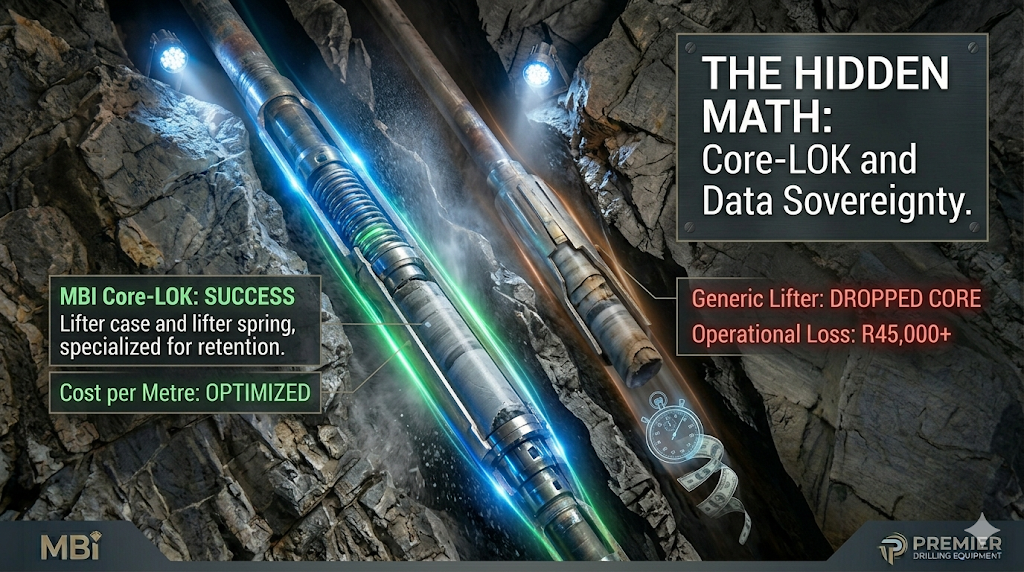
The “Hidden Math” of Core Recovery: Calculating the Cost of a Dropped Tube
In mineral exploration, the final 1,500 meters of drilling are useless if the crucial 1.5-meter sample is lost during the final lift. This catastrophic event—the dropped core—occurs when the mechanical retention system (the core lifter and lifter case) fails at the moment of extraction.
For many operations, procurement decisions are still based on the invoice price of these components. This is a profound miscalculation of operational risk. In deep-hole exploration across Southern Africa—from the gold mines of the Witwatersrand to the complex geology of the Northern Cape—we must move beyond the commodity price and focus on the Total Cost of Ownership (TCO). By utilizing MBI’s superior engineering, we can quantify how a single avoided failure pays for an entire programme’s premium tooling.
The Moment of Retention: Where Data Wins or Loses
When the core barrel has finished its cutting run, the entire rig hinges on a single mechanical interaction: the core lifter must grip the sample as the string is pulled.
- Commodity Failure: Generic or budget core lifters often utilize lower-grade springs or standardized, loose tolerances in the lifter case. Under the intense hydraulic pressure and vibration of deep-hole drilling, these standard components are prone to premature wear, stripping, or loss of positive engagement.
- The MBI Solution (Core-LOK): MBI engineers sample security at the component level. The Core-LOK system utilizes optimized taper angles, high-spec metallurgical spring steel, and precise internal tolerances. This ensures positive, dynamic retention: the more weight that pulls against the lifter, the tighter it grips the sample, guaranteeing data security in fractured or friable ground.
Tallying the Failure: The Financial Anatomy of a Dropped Run
The “Hidden Math” of a dropped core event is staggering. To illustrate the operational economics, we have quantified a single dropped 1.5m sample at 1,000m depth using a standard diamond rig configuration.
Operational Economics: Dropped Run Scenario (1,500m Gold Exploration)
| Cost Driver | Generic Failure Risk (Dropped 1.5m Sample) | MBI Prevention Benefit (Successful Extraction) | Financial & Operational Impact |
|---|---|---|---|
| Tooling Cost | R 1,500 (Lifter/Case replacement) | R 2,800 (MBI Premium Components) | Minimal initial invoice difference. |
| Lost Rig Time (Fishing) | 8 – 14 Hours (Searching/Retrieving) | 0 Hours | Rig Time Cost (R25,000/shift) |
| Data Degradation | Missing critical intersection interval | 100% Core Recovery data | Geological Model Certainty |
| Fuel Waste (Scope 1) | High (Rig idling/low RPM fishing) | Optimized production only | Measured Fuel Reduction (ESG) |
| Operational Risk | High (Potential string damage during fishing) | Minimal | Preserves Capital Equipment |
| The ‘Hidden Math’ Total | ~R 45,000 – R 75,000 Loss | R 2,800 Investment | MBI delivers massive ROI |
| The “cheap” lifter spring costs R1,500 but results in a R45,000+ operational loss. The true cost of the dropped tube is not the tool; it is the lost metres, wasted hours, and compromised data. |
Beyond Commodity: How Core-LOK Eliminates Operational Risk
MBI Core-LOK engineering is not a premium features; it is a fundamental requirement for deep exploration predictability. By utilizing Core-LOK, we achieve:
- Consistent Taper Engagement: The precise machining ensures that the lifter spring seats perfectly within the lifter case, preventing the slippage that leads to stripping.
- Friable Ground Security: In sensitive or fragmented ground (common in geotechnical and complex reef geologies), standard systems often grind the core. Core-LOK grips securely with minimal sample disturbance.
- Predictability in High ROP Environments: Modern bits cut fast. Core-LOK is engineered to match this productivity, ensuring that fast drilling hours are not wasted by slow, anxious core retrieval.
Geologist’s Pro-Tip: Identifying Retention Wear before Failure
Don’t wait for a dropped run to check your lifters. During shift changeover, always inspect the core lifter springs for signs of flattening, pitting, or reduced tension. If the spring ‘gap’ has narrowed or if the lifter case shows uneven wear marks, replace the stack immediately. In complex geology, proactively replacing an MBI lifter assembly is cheaper than one failed run.The Synthesis of Sovereignty and TCO
At Premier Drilling Equipment, we believe that African operations must own their technical predictability. By integrating MBI’s precision engineering—from the bit matrix (Article 1) to the stabilized string (Article 7) and the Core-LOK retention stack (Article 8)—we provide the total visual and data evidence necessary to secure Data Sovereignty.
The math is not hidden; it is simply uncalculated by our competitors. Own your economics and secure your data with Premier and MBI.
Ready to stop losing core revenue to component failure?
Contact the Premier Drilling technical team today for a Core Retention Audit and let us engineer a stabilized drilling solution for your high-stakes programme.