Matrix Hardness vs. Abrasivity: Selecting Diamond Bits for the Kaapvaal Craton
Introduction: Why the Kaapvaal Craton Punishes Poor Bit Selection
Few drilling environments expose poor consumables selection faster than the Kaapvaal Craton.
Quartz-rich formations, banded iron sequences, and hard metamorphic rocks place severe tribological stress on drilling systems. A bit that performs adequately in one lithology may deteriorate rapidly only a few metres deeper when abrasivity changes.
The result is familiar to drilling crews.
Penetration slows. Crown wear accelerates. Gauge loss appears unexpectedly. Rod trips increase. Cost per meter drilled rises while productivity declines.
In these conditions, poor bit performance is often blamed on rock hardness.
That assumption is incomplete.
Hardness and Rock Abrasivity are not the same mechanical problem.
A formation may be extremely hard but relatively non-abrasive, while another may wear tooling aggressively despite lower compressive strength. In the Kaapvaal environment, quartz-rich lithologies punish bits primarily through abrasion, heat generation, and instability.
This makes Diamond Drill Bits selection an engineering problem rather than a procurement decision.
The correct matrix profile, diamond exposure rate, and hydraulic design determine whether productivity remains stable or deteriorates into expensive downtime.
Understanding the Geology of the Kaapvaal Craton
Why Kaapvaal Formations Behave Differently
The Kaapvaal Craton contains some of the most mechanically demanding exploration conditions in Southern Africa.
Common drilling environments include:
- Quartzites
- Metamorphic formations
- Highly silicified intervals
- Banded Iron Formation (BIF)
- Abrasive sedimentary sequences
Many of these formations contain elevated quartz concentrations.
Quartz behaves differently under drilling loads because it acts as an aggressive abrasive medium. Rather than simply resisting penetration, quartz-rich cuttings continuously scour the drill crown, accelerating wear and destabilizing performance.
This explains why compressive strength alone is misleading.
A formation may appear manageable from a hardness perspective while consuming bits at an unsustainable rate.
Hardness vs Abrasivity
Hardness measures resistance to deformation.
Abrasivity measures wear potential.
The distinction matters operationally.
In drilling terms:
- Hardness influences cutting resistance and penetration.
- Rock Abrasivity governs wear rate, crown erosion, heat generation, and tool fatigue.
Quartzite drilling illustrates this clearly.
Even when penetration remains acceptable, excessive abrasion may strip matrix material prematurely, destabilize diamond exposure, and reduce Drill Bit Life significantly.
Effective tooling decisions must therefore account for both.
Matrix Hardness and Controlled Wear
What Matrix Hardness Actually Controls
Matrix Hardness determines how the metallic bond surrounding impregnated diamonds wears during drilling.
Its purpose is not maximum durability.
Its purpose is controlled sacrificial wear.
The matrix must gradually erode so fresh diamonds remain exposed as cutting surfaces degrade.
In abrasive formations, this balance becomes difficult.
Too much wear destroys the crown prematurely.
Too little wear produces glazing and polishing.
The objective is controlled refresh.
When the Matrix Is Too Soft
An excessively soft matrix deteriorates rapidly in abrasive ground.
High quartz content aggressively strips matrix material, causing diamonds to lose support before completing their cutting cycle.
Operational consequences include:
- Premature stripping
- Accelerated crown erosion
- Rapid gauge loss
- Short bit runs
- Increased rod trips
While penetration may initially appear aggressive, overall drilling economics deteriorate quickly.
Frequent replacement increases downtime and consumables usage.
When the Matrix Is Too Hard
An overly hard matrix fails differently.
Instead of exposing fresh diamonds, the matrix retains worn cutting surfaces too long.
This creates:
- Crown polishing
- Matrix glazing
- Reduced cutting aggressiveness
- Heat buildup
- Lower Rate of Penetration (ROP)
The bit becomes inefficient despite appearing structurally intact.
Operators often respond by increasing WOB or RPM.
In abrasive formations, this frequently worsens instability.
Correct Matrix Balance
The correct matrix behaves predictably.
It wears gradually enough to expose new diamonds while resisting catastrophic stripping.
Proper balance supports:
- Stable Matrix Wear
- Improved Rate of Penetration (ROP)
- Longer drilling intervals
- Better thermal stability
- Consistent performance
In practical drilling terms, successful bits wear evenly.
Diamond Impregnation and Bit Life
Why Diamond Exposure Matters
Diamond Impregnation controls cutting availability.
Synthetic diamonds embedded within the crown gradually emerge as matrix material wears.
Exposure rate influences:
- Cutting efficiency
- Heat generation
- Crown stability
- Bit sharpness
- Wear consistency
Insufficient exposure reduces cutting efficiency.
Excessive exposure increases diamond breakage and instability.
The objective is controlled progression.
Matching Bit Design to Quartzite and BIF
In Quartzite Drilling and Banded Iron Formation (BIF), diamond exposure must account for severe abrasive loading.
Poor matching commonly produces:
- Accelerated polishing
- Crown instability
- Uneven wear
- Reduced bit life
- Excessive vibration
Field performance improves when matrix behaviour and impregnation depth align with actual formation response rather than assumed hardness.
The best-performing bit is rarely the hardest.
It is the most mechanically balanced.
Waterway Design, Cooling, and Hydraulic Stability
Why Hydraulics Influence Drill Bit Life
Hydraulics directly influence wear progression.
Without effective cooling and flushing, abrasive cuttings recirculate across the crown, effectively re-grinding the bit during operation.
Waterway Design becomes critical.
Efficient waterways support:
- Cooling efficiency
- Heat reduction
- Cuttings evacuation
- Reduced abrasive recirculation
- Improved crown stability
Poor flushing increases frictional heating and accelerates crown deterioration.
Heat damages both diamonds and matrix metallurgy.
In abrasive environments, cooling becomes a productivity variable.
Managing Vibration and Wear
Wear acceleration is rarely caused by abrasivity alone.
Mechanical instability contributes significantly.
Common failure mechanisms include:
- Slip-stick
- Torsional loading
- Drill string vibration
- Eccentric rotation
Vibration creates uneven loading across the crown.
Consequences include:
- Irregular wear patterns
- Uneven gauge loss
- Diamond fracturing
- Reduced Drill Bit Life
Stable drilling mechanics extend consumable life.
Unstable mechanics destroy it.
How to Diagnose Poor Bit Selection Before Productivity Collapses
Most bit failures show warning signs long before catastrophic deterioration occurs.
Operators should monitor performance trends continuously.
Bit Selection Diagnostic Checklist
Watch for:
- Rapid gauge loss indicating unstable matrix behaviour
- Polished crown surfaces suggesting glazing
- Reduced ROP despite consistent drilling parameters
- Excessive heat generation at the crown
- Diamond stripping before expected run life
- Irregular wear patterns around the bit face
- Torque instability or erratic drilling feel
- Excessive drill string vibration
- High consumables usage relative to expected meterage
Minor symptoms often signal mismatched matrix selection.
Correcting the problem early reduces downtime and waste.
The Economics of Correct Bit Selection
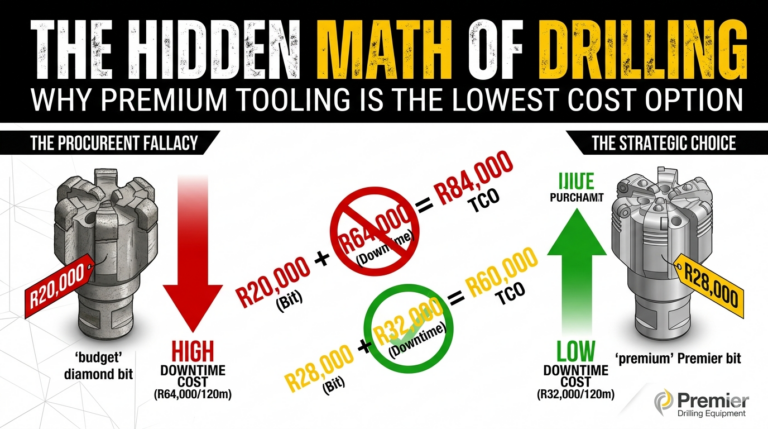
The cheapest bit often becomes the most expensive operational decision.
Consider a simplified comparison.
| Performance Area | Incorrect Bit Selection | Correct Matrix Match |
| Drill bit life | Short | Extended |
| ROP | Inconsistent | Stable |
| Cost per meter | High | Lower |
| Rod trips | Frequent | Reduced |
| Downtime | Elevated | Reduced |
| Consumables waste | High | Controlled |
| Production consistency | Poor | Reliable |
In abrasive formations, premature failure compounds costs rapidly.
Each rod pull increases lost time. Reduced penetration slows drilling progress. Unstable performance affects scheduling certainty.
By contrast, a properly matched bit improves continuity and lowers operational variability.
Performance becomes predictable.
Prevention Strategy: Building a Kaapvaal Drilling Program
Formation-Specific Planning
Tooling should match geology.
Quartzites, Banded Iron Formation (BIF), and abrasive metamorphic sequences require different wear strategies.
Bit selection should reflect field conditions, not assumptions.
Monitoring Matrix Wear
Crews should inspect bits routinely for:
- Crown wear symmetry
- Gauge integrity
- Diamond exposure behaviour
- Heat indicators
- Polishing
Wear patterns provide operational feedback.
Hydraulic Discipline
Cooling matters.
Drilling crews should maintain:
- Stable flushing
- Efficient cuttings evacuation
- Consistent circulation
- Thermal control
Good hydraulics reduce wear acceleration.
Data-Led Consumables Selection
Consumables performance should be tracked.
Useful indicators include:
- Rate of Penetration (ROP)
- Meterage per bit
- Wear behaviour
- Rod trip frequency
- Failure patterns
Operational data improves tooling decisions.
Conclusion
Selecting Diamond Drill Bits for the Kaapvaal Craton is fundamentally an engineering exercise.
Success depends on matching Matrix Hardness, Diamond Impregnation, and Waterway Design to Rock Abrasivity, not simply formation hardness.
Quartz-rich formations punish poorly matched consumables through premature wear, glazing, instability, and heat generation.
The most productive drilling programs treat bit selection as a geology-specific performance decision.
When matrix behaviour, cooling efficiency, and wear mechanics align with formation conditions, Drill Bit Life improves, Rate of Penetration (ROP) stabilizes, downtime declines, and cost per meter drilled becomes more predictable.
In the Kaapvaal environment, precision selection consistently outperforms cheap replacement.